

Walking the floor at Surfaces every year is a good reminder that not everything new is meaningful—and not everything meaningful is loud.
What stood out in 2026 wasn’t a single breakthrough product. It was a series of thoughtful refinements happening across the industry: warmer colors, better realism, smarter materials, and floors designed for specific applications instead of one-size-fits-all solutions.
Here’s what we’re actually seeing and bringing home from Surfaces 2026.
Warmer, Earth-Driven Colors—and a Thoughtful Return to Darker Tones
The move away from cool gray flooring is no longer a prediction—it’s established reality. What’s evolving in 2026 is where color is settling.
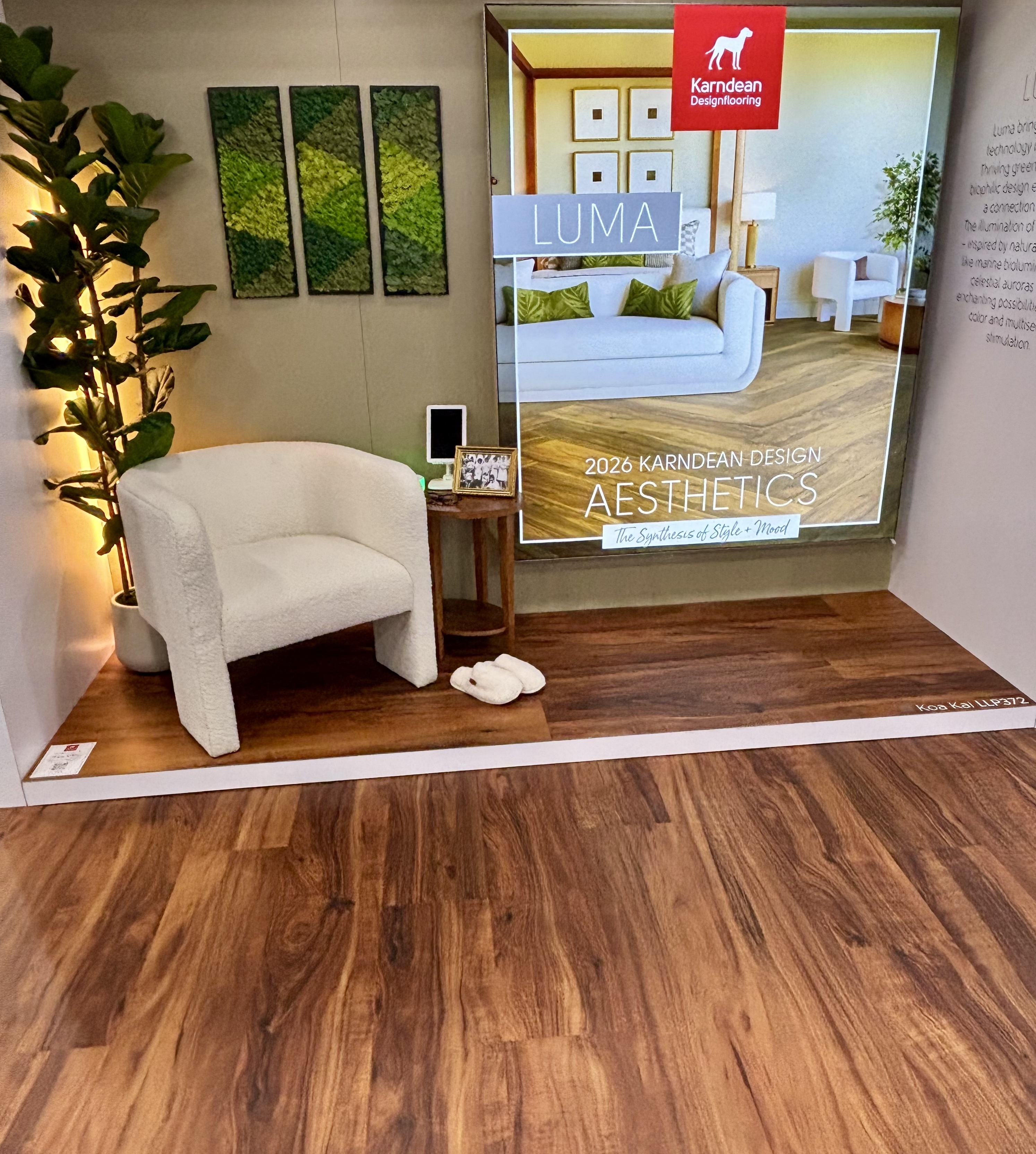
Across hardwood, vinyl, laminate, and hybrid floors, manufacturers are leaning into warmer, earth-driven tones: honey, caramel, chestnut, walnut, and warm beige neutrals that feel natural rather than manufactured. These colors work with light instead of against it, and they age far more gracefully than the gray-heavy palettes of the last decade.
Alongside that shift, darker colors are making a measured comeback. Not the near-black floors that dominated years ago, but richer mid-to-dark browns with depth and nuance. When paired with matte finishes and realistic texture, these darker tones add contrast and sophistication without overwhelming a space.
The common thread is balance. Floors are no longer trying to be the star of the room—they’re grounding it.

Sharper Visuals, Real Materials, and Finishes That Feel Right
One of the biggest quality jumps we saw at Surfaces 2026 was how convincing high-end flooring has become—especially when you look closely. Manufacturers are no longer “designing” wood visuals from scratch. They’re starting with real materials and working backward.
A standout example is Karndean, which is scanning actual koa wood and natural marble to develop its visuals. That approach captures real grain movement, natural color variation, and subtle imperfections—the things that make a floor feel authentic instead of repetitive.
Those sharper visuals are being paired with matte and low-sheen finishes, which continue to replace glossy surfaces across categories. Matte finishes feel more natural, hide everyday dust and footprints better, and simply perform better in lived-in homes.
At the same time, embossed-in-register (EIR) technology is becoming the expectation on better floors, not a premium add-on. When the texture lines up exactly with the visual grain, the floor feels believable underfoot—not just at a glance.
Together, sharper visuals, matte finishes, and EIR are raising the baseline for what “good flooring” looks and feels like.
SPC Isn’t Going Away—but It’s Being Rebalanced
SPC had a moment where it became the answer to almost every flooring question. In 2026, the industry is pulling back from that mindset. SPC is still a great product—but it’s being repositioned, not replaced.
We’re seeing manufacturers expand into:
WPC and Ultra-thick WPC for added stability, comfort and acoustics
Next-generation laminates that solve problems SPC never fully addressed
Hybrid Hardwood floors to provide the look and feel of wood with the cost and durability of a composite floor
A good example of where SPC is heading is the ultra-thick SPC category, like the Vortis Norden Home collection from Johnson Hardwood. Thicker constructions improve dimensional stability and help SPC feel less rigid underfoot, making it more appropriate for residential spaces than earlier thin-core versions.
At the same time, laminate is making a quiet but meaningful return—especially with waterproof, PVC-free laminates that deliver excellent scratch resistance and a more natural feel. Newer products like Evolv from TruTouch Floors and the Pacific Vineyard Collection from SLCC Flooring show how far laminate has come. These floors combine realistic visuals, durable wear layers, and improved moisture resistance—without relying on vinyl at all.


Then there are true hybrids, like the new rigid core floor from Amorim, which sandwiches a rigid core between a cork underlayment and a cork veneer. The result is a floor that installs like an LVP but feels noticeably softer, quieter, and warmer underfoot.
The big shift here is intention. Instead of forcing one product into every application, manufacturers are finally designing floors for how and where they’ll actually be used.
More Widths, Herringbone, and Parquet—Designed as Complete Systems
Another noticeable evolution is how collections are being built. Rather than offering a single plank and calling it a day, more manufacturers are releasing coordinated systems: multiple plank widths, along with matching herringbone and parquet formats designed to work together.
This gives homeowners and designers the flexibility to create a dramatic entryway or feature space while maintaining a cohesive look throughout the rest of the home. It also removes the guesswork—and risk—of mixing unrelated products. The floor becomes part of the design conversation, not an afterthought.

Pillowed Edges Are Returning as a Softer Alternative
Edge detail is subtle, but it plays a big role in how a floor looks once installed. After years dominated by sharp micro-bevels or deep painted bevels, more LVP and laminate manufacturers are offering pillowed edges again. These edges soften the transition between planks, create gentler shadow lines, and feel more natural—especially on wider boards.
Despite a common misconception, bevels don’t trap dirt. Dust settles across the entire surface of a floor, and properly finished bevels clean just as easily. In fact, sharper micro-bevels can sometimes look dirtier because hard shadow lines exaggerate dust in certain lighting.
Pillowed edges align with the broader shift we’re seeing toward warmth, realism, and comfort.

Manufacturing Is Quietly Shifting Worldwide
One of the most important flooring trends for 2026 isn’t something you can see on the surface. Behind the scenes, manufacturers are actively diversifying production away from China and into countries like Vietnam, Taiwan, and Malaysia and bringing manufacturing of select hardwoods, laminates, and PVC-free rigid core floors back to the United States. The goal is to reduce tariff exposure, stabilize supply chains, and build more reliable long-term sourcing.
For homeowners, this shift goes far beyond geopolitics. It directly impacts pricing stability, lead times, and product availability—especially when it comes to higher-quality, better-made flooring.

The Big Takeaway for 2026
Flooring in 2026 is less about chasing trends and more about refinement.
Warmer colors. Better realism. Smarter materials. Softer edges. Purpose-built products. And manufacturing strategies designed for the long term.
That’s what stood out at Surfaces this year—and that’s what we’re focused on curating for our customers.


