

The Ultimate Tile Flooring Buyer’s Guide
Tile is one of the most durable and design-flexible surface materials available for homes and commercial spaces. It offers exceptional moisture resistance, longevity, cleanability, and design versatility while performing extremely well in kitchens, bathrooms, showers, lanais, and indoor-outdoor environments. With options ranging from porcelain and ceramic to natural stone and large-format panels, tile allows homeowners to create finishes that range from timeless and traditional to sleek and modern.
At Paradise Flooring in Honolulu, we focus on professionally specified tile systems designed to perform well in Hawaii’s demanding indoor-outdoor environment. We evaluate tile products and installation systems based on durability, slip resistance, waterproofing compatibility, substrate preparation requirements, maintenance expectations, and long-term serviceability. This guide explains how tile systems are built, where each type performs best, and what to consider when selecting tile for your project.

Best Uses for Tile in Hawaii

How Tile Flooring Is Typically Constructed
Unlike floating floors, tile is usually a bonded system. The visible tile is only one part of the assembly. Long-term performance depends on the layers underneath it.
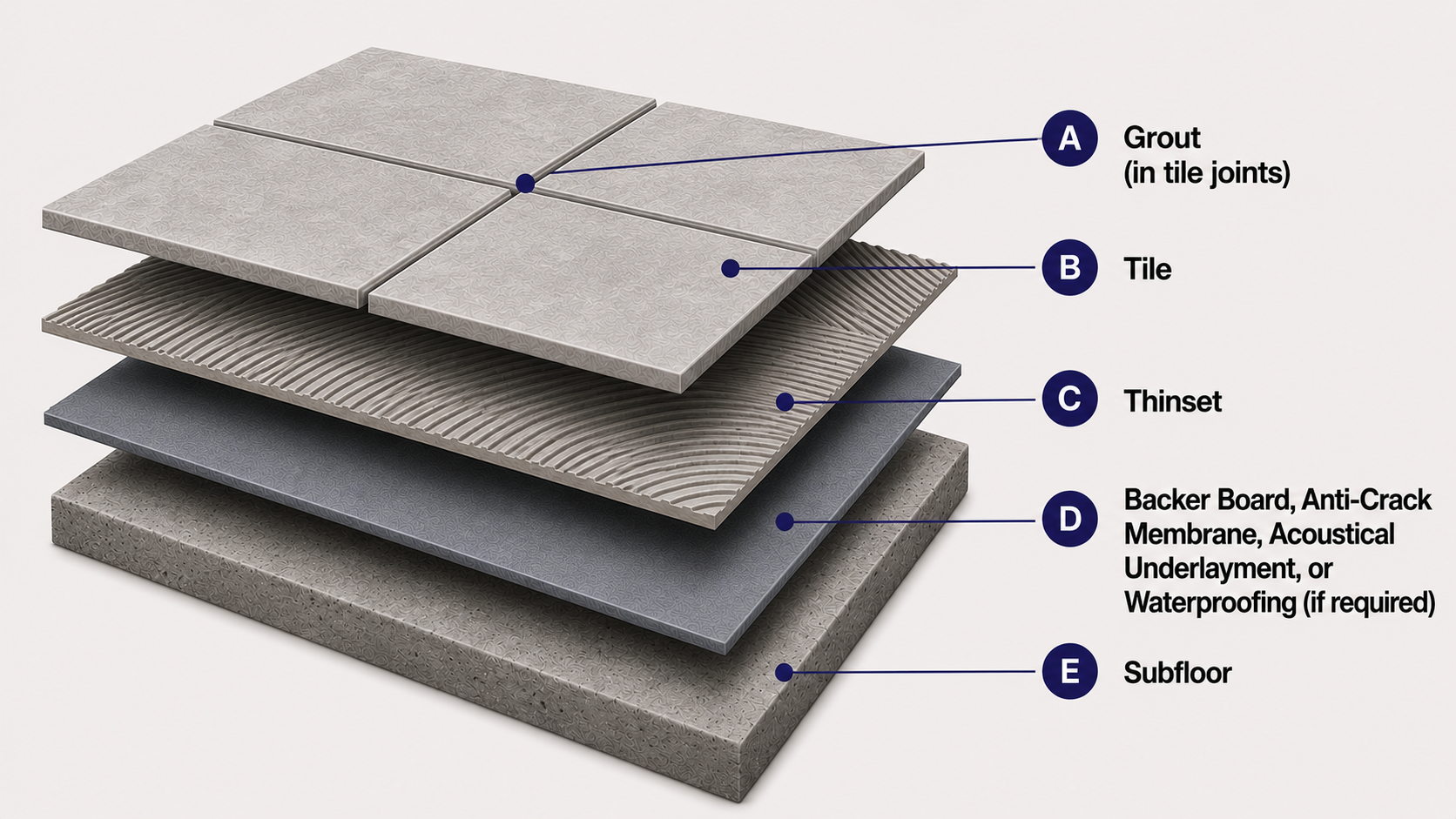
The Grout Joint (A) fills the space between tiles and plays both a functional and aesthetic role. Grout helps accommodate normal manufacturing variation between tiles, defines the pattern, and can dramatically influence the final appearance depending on whether the grout color blends with or contrasts against the tile. Movement Joints may be needed to allow the tile assembly to expand and contract naturally from temperature changes, structural movement, and sun exposure.
The Tile (B) is the visible finish layer and can be porcelain, ceramic, natural stone, quarry tile, cement tile, mosaics, or specialty formats. This layer determines the overall appearance, texture, durability, and slip resistance of the finished installation.
The Thinset Mortar (C) is the bonding layer that secures the tile to the substrate or membrane. Different tile types, sizes, and applications often require different mortars, which is why proper product selection is important.
Beneath the tile, installers may use a Waterproofing, Crack Isolation, Uncoupling, or Sound-Control Membrane (D) depending on the application. Waterproofing membranes are commonly used in showers and wet areas. Crack-isolation membranes help reduce the transfer of small substrate cracks into the tile assembly. In condominiums, acoustic underlayments can help reduce impact sound transmission between units.
Different Types of Tile
Natural Stone
Finish Types and Slip Resistance (DCOF)
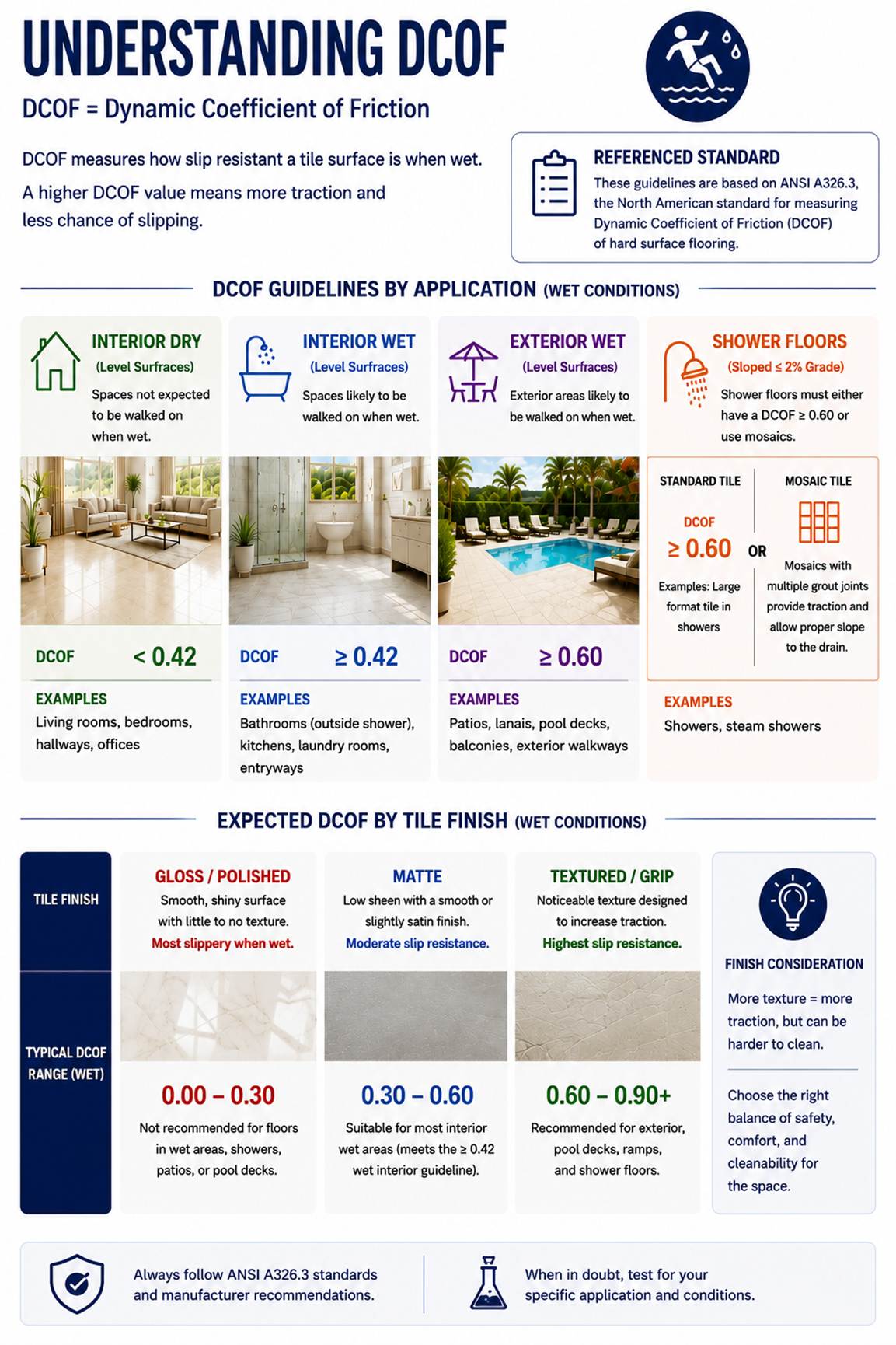
One of the most important considerations is selecting the right tile for the right location. A glossy or polished tile may be an excellent choice for shower walls, backsplashes, or decorative feature walls because it is attractive and easy to clean, but it can be a poor choice for floors where slip resistance is important. Conversely, heavily textured grip tiles can provide excellent traction on pool decks, lanais, and exterior walkways, but may require more effort to clean in interior applications. Matte tiles remain popular because they provide a good balance between traction, comfort, and cleanability. For shower floors, small mosaics are often preferred because the additional grout joints help improve traction and allow proper slope to the drain.
Some manufacturers now offer slip-enhancing technologies designed to improve traction without creating an overly aggressive surface texture. StepWise is a feature available on select Daltile, Marazzi, and American Olean porcelain tiles. Rather than being applied as a topical coating, the slip-enhancing properties are infused directly into the tile surface. Daltile states that StepWise products achieve a DCOF of at least 0.60, exceeding the commonly referenced 0.42 standard for interior wet areas.
DCOF should be used as a guideline, not a guarantee against slipping. No tile is completely slip proof under all conditions, and real-world performance can be affected by water, oil/soap residue, slope, drainage, footwear, contaminants, and maintenance.
Durability Ratings and Why They Matter
Tile spec sheets can contain a surprising amount of technical information, including MOHS hardness, abrasion resistance, breaking strength, chemical resistance, water absorption, shade variation, and DCOF. While these ratings can be useful, it's important not to get lost in the numbers.
MOHS is a scratch hardness scale that measures a material's resistance to scratching from harder materials. Higher numbers generally indicate greater scratch resistance. However, MOHS is only one piece of the puzzle. A tile's suitability for a particular application depends on many factors, including finish type, slip resistance, abrasion resistance, and whether the tile is approved for the intended use.
For most homeowners, the most important consideration is simply making sure the tile is rated for where it will be installed. A beautiful glossy wall tile may not be suitable for a floor. A polished floor tile may not be appropriate for a shower floor. Likewise, not every floor tile is approved for exterior use, pool decks, or commercial environments.
Rather than focusing on a single specification, look at the tile as a complete package and confirm it is rated for the application. When in doubt, ask the manufacturer or your flooring professional before installation.
Shade Variation: V1, V2, V3, and V4
Wall Formats and How to Choose
Floor Tiles vs Wall Tiles
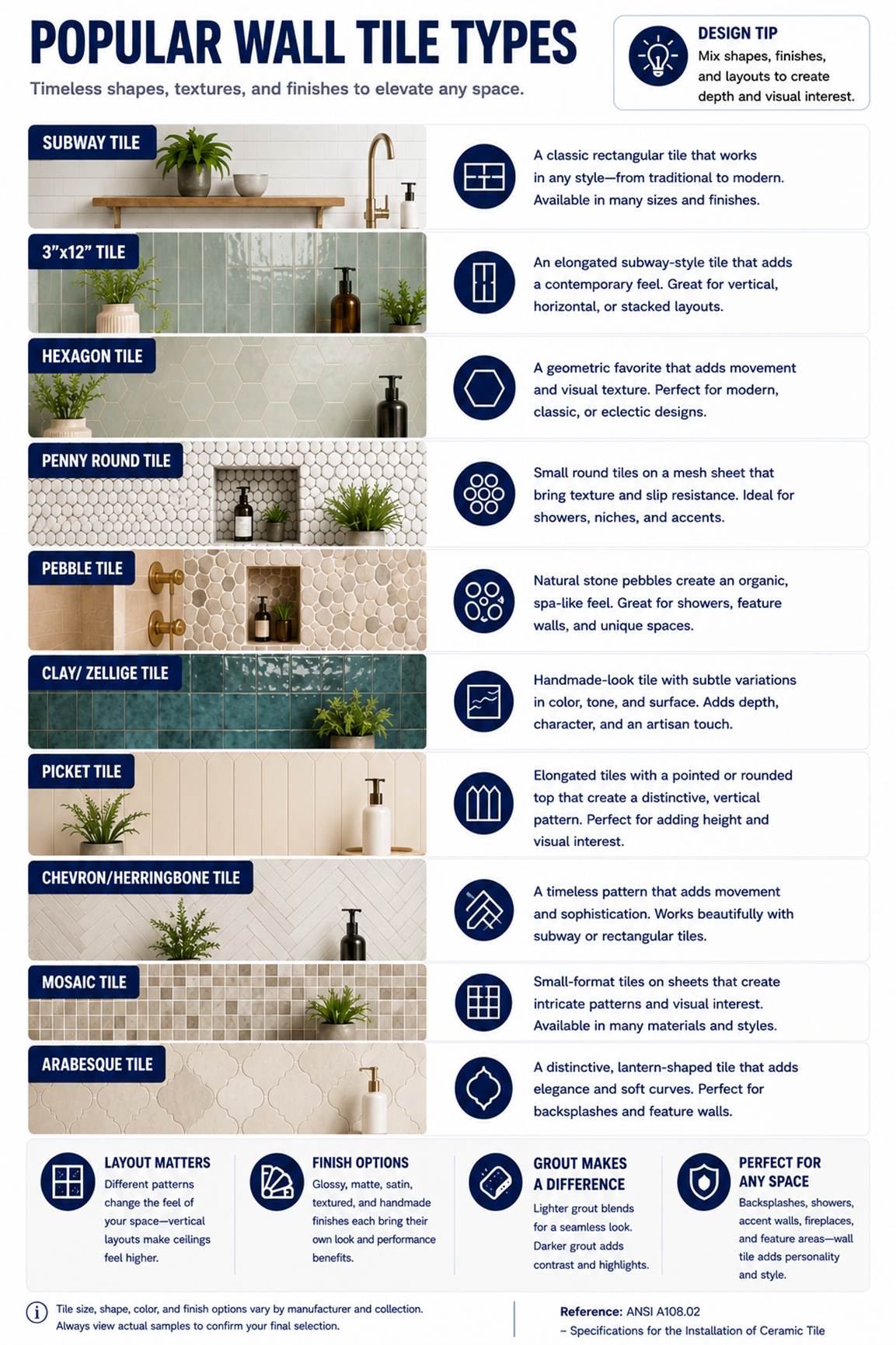
Floor tile must be rated for foot traffic, abrasion, and slip resistance. Wall tile does not need to meet the same performance demands and may be thinner, softer, glossier, or more decorative. Floor tile can usually be installed on walls if the wall assembly can support it, but wall tile should not be installed on floors unless the manufacturer rates it for floor use.
For shower floors, smaller formats are typically preferred because they follow the slope to the drain and provide more grout lines for traction. For shower walls, larger formats can reduce grout lines and create a cleaner look. For backsplashes, design and cleanability often matter more than abrasion resistance.
Aesthetics: How to Pick Tile
Tile selection usually starts with the look, but the best result comes from balancing style with the room, lighting, maintenance expectations, and installation details.
- Choose the overall design direction first: stone-look, concrete-look, wood-look, handmade, terrazzo, encaustic, marble-look, minimalist, tropical, or classic.
- Decide whether the tile should be quiet and consistent or full of movement and variation.
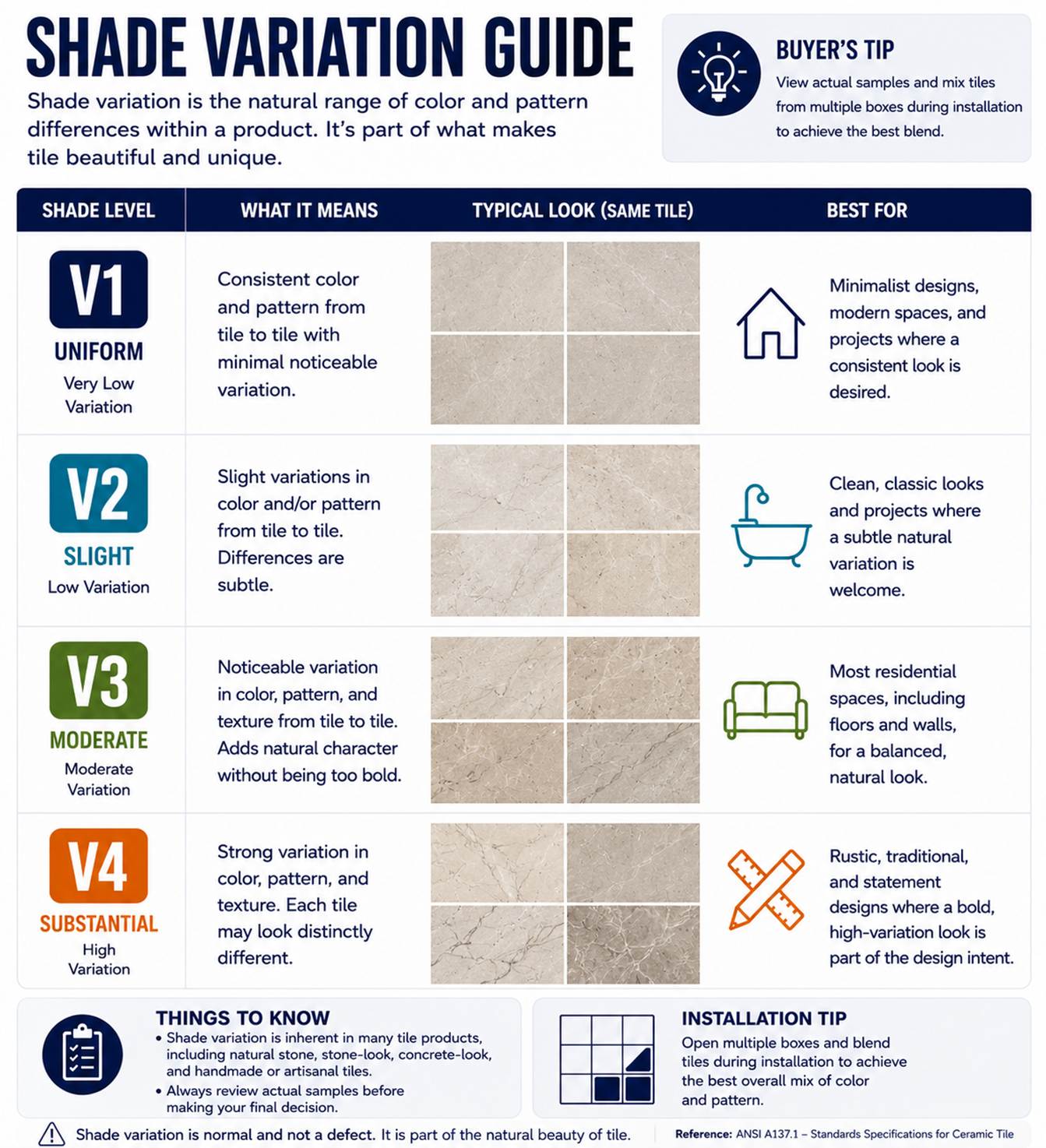
- Look at several pieces, not just one sample. This is especially important for V3 and V4 products, marble looks, stone looks, and natural stone.
- Coordinate the grout color early. Matching grout makes the floor read as a single surface; contrasting grout highlights the pattern.
- Think through the edge details, transitions, niches, corners, and trims before installation starts.
- Use matte or textured finishes for areas that may get wet. Use glossy and polished finishes carefully on floors.
- Consider scale. Large tiles can make open spaces feel clean and expansive, while small tiles and mosaics create detail, texture, and grip.
Tile Patterns, Offset Layouts, and Lippage
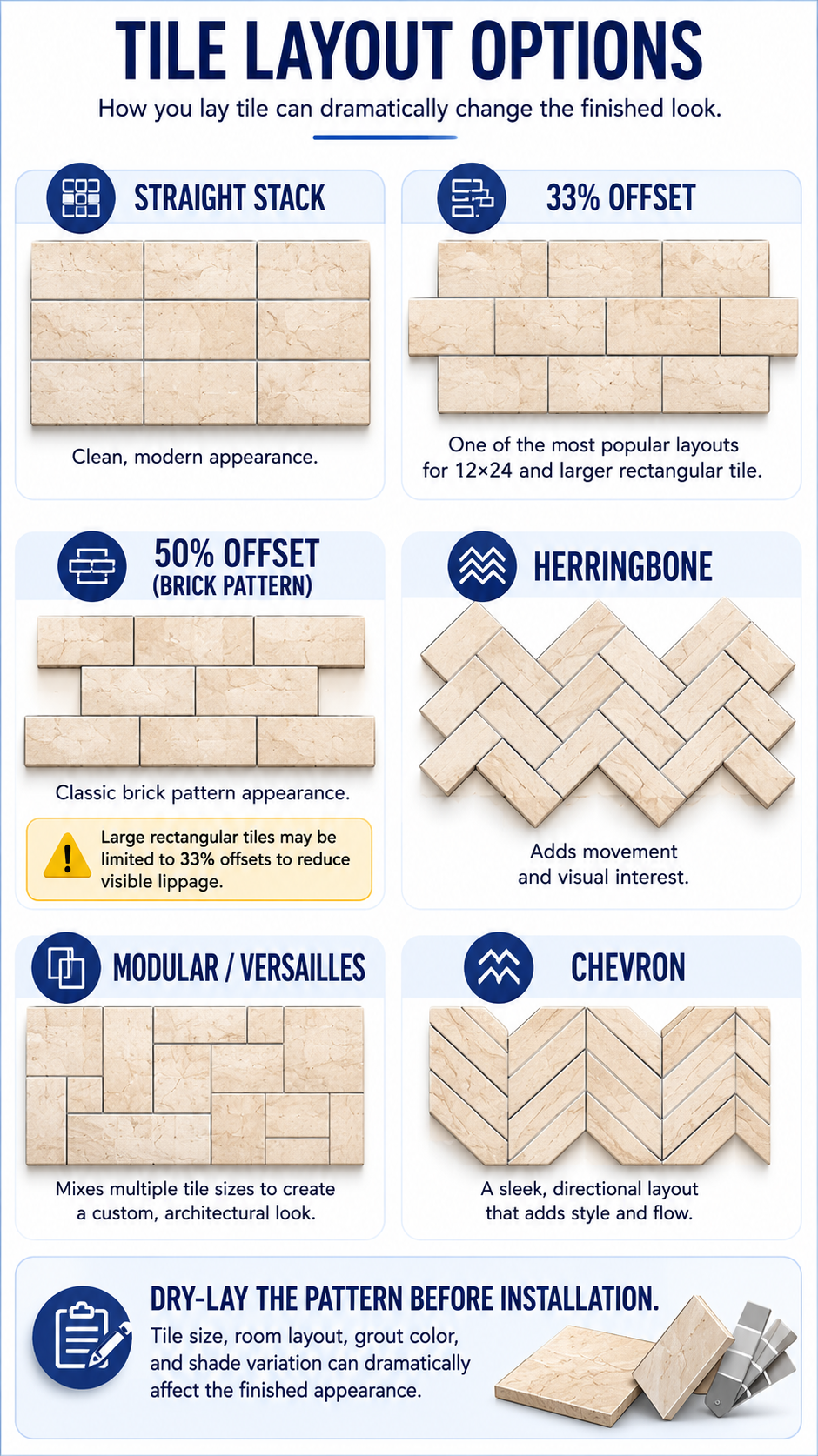
Tile layout is not just a design choice. It affects how flat the finished floor looks, where cuts land, and how much lippage is visible. Large rectangular tiles can have a slight “bow” to them. If they are installed in a 50 percent brick pattern, the high point of one tile can meet the low point of another, making lippage more noticeable.
Installation Systems and Products
Tile installation is a system. The right system depends on the substrate, tile size, tile type, exposure to water, movement, sound requirements, and whether the project is residential, commercial, interior, exterior, or wet area. The challenge is that tile is also one of the most installation-dependent flooring categories. A great tile installed over the wrong substrate, with the wrong mortar, without movement joints, or without the right waterproofing or crack isolation system can still fail. At Paradise Flooring in Honolulu, we help homeowners, designers, contractors, and property managers compare tile options based on the full system, not just the look of the surface. The tile, thinset mortar, grout, membrane, substrate preparation, transitions, and layout all work together.
Substrate Preparation
The surface must be clean, flat, stable, and structurally sound. Remove contaminants such as paint, curing compounds, dust, grease, sealers, old adhesive residue, and loose material. Concrete must be evaluated for moisture, cracks, flatness, and surface condition. Wood subfloors must meet deflection and thickness requirements for tile or stone.Thinset Mortar
Thinset mortar bonds the tile to the substrate or membrane. Basic mortars may work for simple ceramic tile on suitable substrates, but porcelain, large-format tile, exterior areas, wet areas, glass tile, stone, and challenging substrates often require modified or specialty mortars. Large and heavy tile mortars help support bigger tiles and reduce slump. White mortar is often used under translucent stone, light stone, or glass tile to prevent shadowing or discoloration.
Grout
Grout fills the joint between tiles and contributes to the finished look. Cementitious grout is common and economical. High-performance cement grouts improve color consistency, stain resistance, and installation properties. Premixed and urethane grouts can provide stain resistance and convenience in certain applications. Epoxy grout offers very high stain and chemical resistance and does not require sealing, but it costs more and requires installers who understand its working time and cleanup requirements.
When to Use Epoxy Grout
Epoxy grout is worth considering in showers, kitchen backsplashes, commercial bathrooms, restaurants, high-traffic areas, rental properties, areas exposed to staining, and spaces cleaned frequently. It is especially useful where stain resistance matters. For harsh commercial kitchens, institutional kitchens, or areas exposed to high heat, aggressive cleaners, or chemical exposure, use the grout system recommended by the manufacturer for that environment.
Waterproofing, Crack Isolation, and Uncoupling
Tile and grout are not a waterproofing system by themselves. In showers, wet rooms, tub surrounds, and certain exterior areas, waterproofing must be designed into the assembly. Sheet membranes, liquid-applied membranes, waterproof boards, and integrated shower systems can all work when installed correctly.
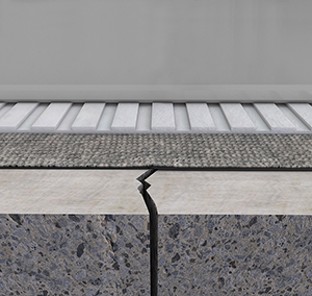
Crack isolation membranes help reduce the chance that small substrate cracks will telegraph through to the tile. They are not magic and cannot fix structural movement, active cracks, or poor substrates. ANSI A118.12 is the common standard for crack isolation membranes. Waterproof membranes for thin-set tile and stone installations are covered under ANSI A118.10. Bonded sound reduction membranes are covered under ANSI A118.13.
Uncoupling membranes are another category used to help manage movement between the substrate and tile. They are commonly used over concrete and wood assemblies, but they must be installed according to the manufacturer’s instructions and the correct mortar requirements.
Sound Control Underlayments for Tile
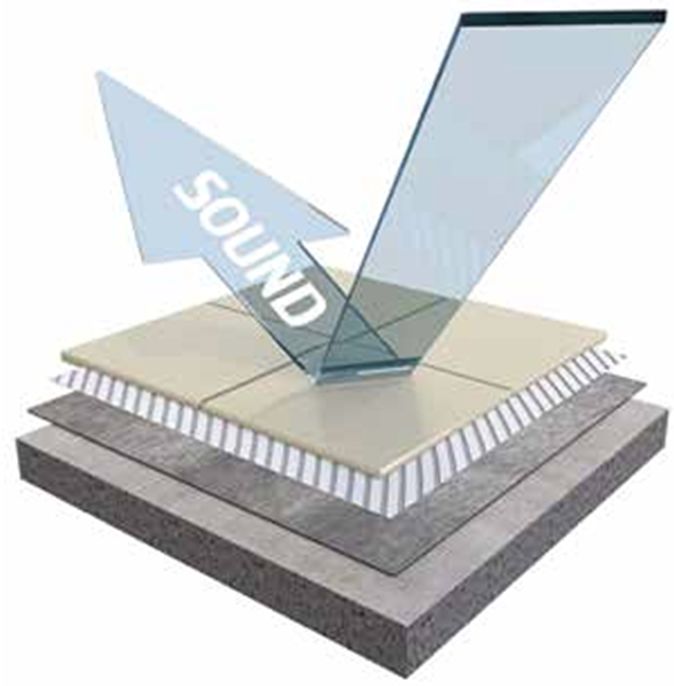
Tile is a hard surface, so it can transmit impact noise in condominiums and multi-family buildings. In Hawaii, AOAO acoustic requirements can be strict and sometimes confusing. The correct approach is to review the building’s requirements, the tested assembly, the slab type, whether there is a ceiling below, and the approved underlayment systems before installation.
Peel-and-stick acoustical membranes as Proflex MSC90 or WhisperMat CS, or a crumb rubber underlayment like GenieMat, QT Sound/QTscu, and can help reduce impact sound. Some systems also provide crack isolation or crack suppression. The key is that the underlayment must be approved for tile or stone, compatible with thinset mortar, and supported by the manufacturer’s test data for the actual floor-ceiling assembly.
Do not compare sound ratings without looking at the full assembly. A rating from a concrete slab with a drop ceiling below is not the same as a bare six-inch slab with no ceiling. For AOAO submittals, the underlayment, tile assembly, adhesive, membrane, and test report should all be reviewed together.
Tile Transitions and Edge Details
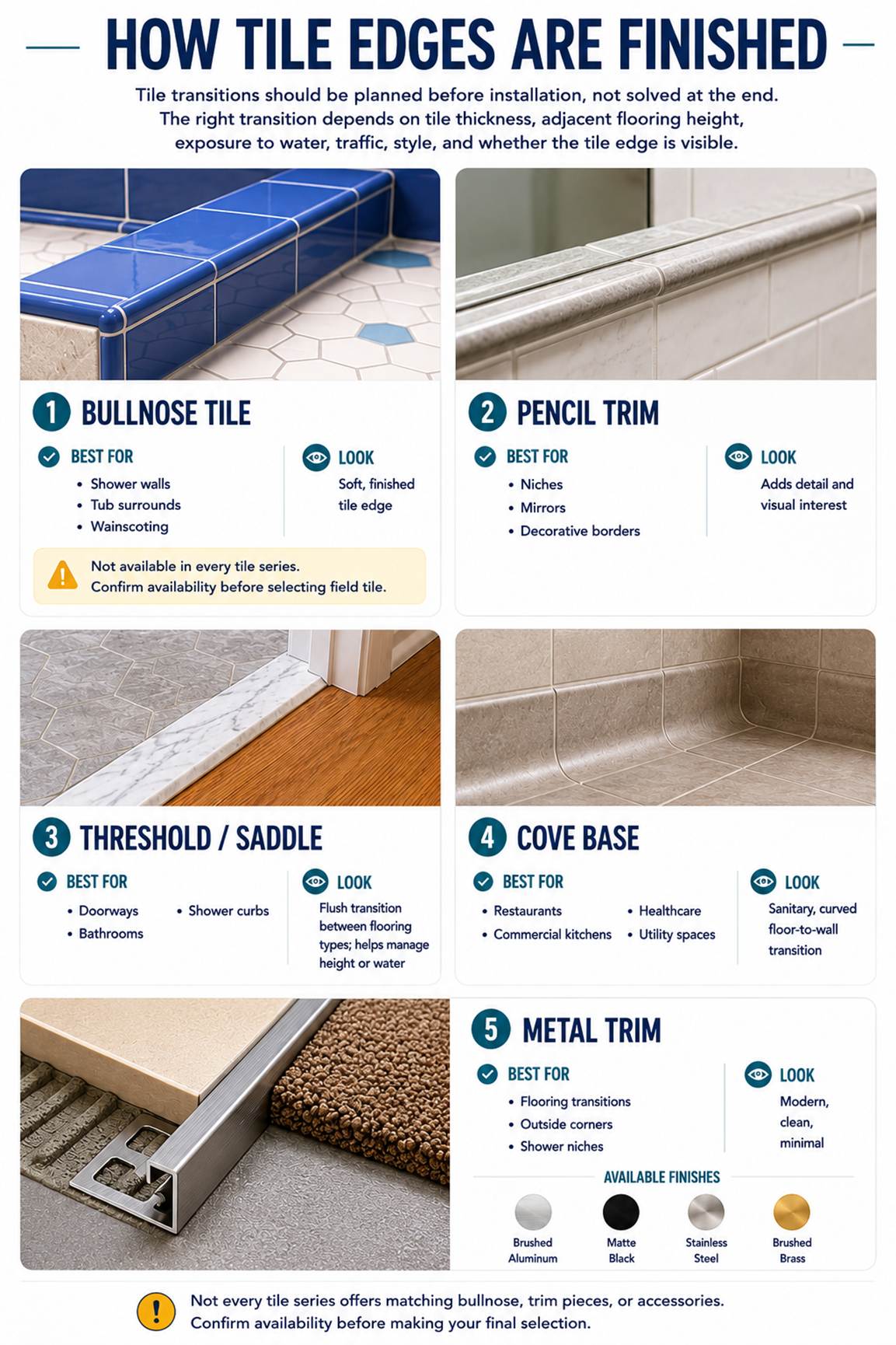
Tile transitions should be planned before installation, not solved at the end. The right transition depends on tile thickness, adjacent flooring height, exposure to water, traffic, style, and whether the tile edge is visible.
Sustainability and Indoor Air Quality
Tile has a strong sustainability story because it is made from abundant mineral materials, can last for decades, and does not need to be replaced frequently when installed correctly. Porcelain and ceramic tile are inert, do not contain PVC, and are generally easy to clean without harsh chemicals. Many manufacturers also publish environmental product declarations, recycled content information, manufacturing location, and indoor air quality documentation.
The biggest sustainability advantage of tile is longevity. A tile installation that lasts for decades can reduce replacement cycles, landfill waste, and the need for repeated remodeling. The installation system matters here too: a long-lasting tile floor requires proper substrate preparation, movement accommodation, mortar coverage, waterproofing where needed, and appropriate grout.
Common Mistakes When Buying Tile
- Choosing tile based only on the look without checking floor, wall, shower, exterior, or commercial usage ratings.
- Using glossy wall tile on a floor or wet area where slip resistance matters.
- Ignoring DCOF, especially for bathrooms, shower floors, lanais, pool areas, entries, and commercial spaces.
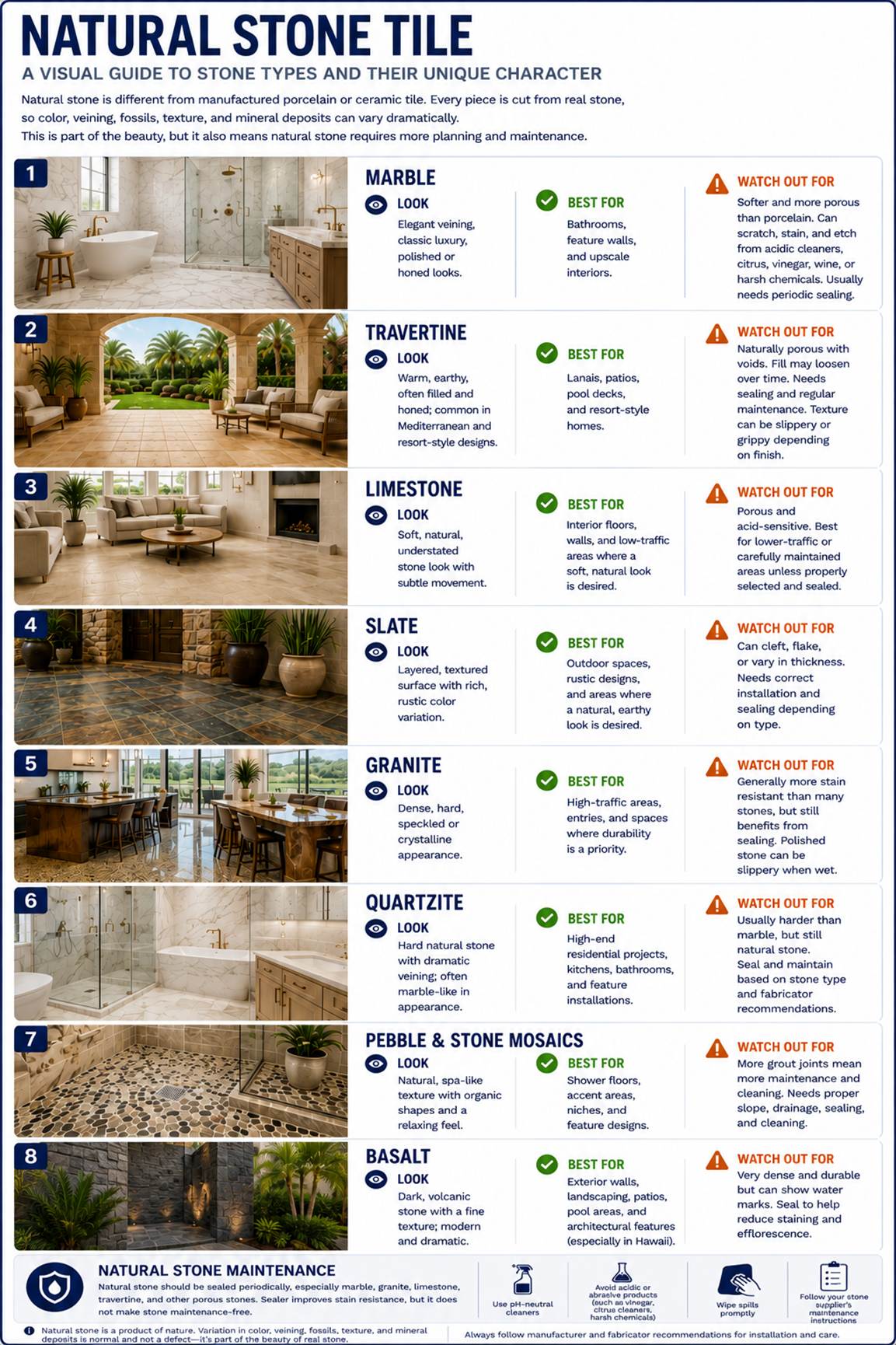
- Selecting natural stone without understanding sealing, staining, etching, and maintenance requirements.
- Using a 50 percent brick offset on large rectangular tiles without checking flatness, warpage, and manufacturer recommendations.
- Forgetting trims, bullnose, jolly profiles, metal transitions, thresholds, and edge details until after installation begins.
- Skipping waterproofing in showers or assuming tile and grout are waterproof by themselves.
- Ignoring sound-control requirements in condos and multi-family buildings.
- Not mixing tile from several cartons, especially with V3 or V4 variation.
- Using the wrong mortar or grout for porcelain, stone, large-format tile, glass tile, submerged areas, or commercial kitchens.

Why Buy from Paradise Flooring
At Paradise Flooring, we take an educational and consultative approach to flooring selection. We help customers compare flooring and select the right products based on their project-specific needs, not just marketing claims or showroom trends.
Our showroom features carefully selected products from reputable manufacturers chosen for their value, quality, performance, and suitability for Hawaii’s unique climate and lifestyle.
We hope this Buyer’s Guide has helped you better understand Tile and the important factors to consider when selecting a product for your home or project. If you still have questions or would like help comparing options, please don’t hesitate to call, visit our showroom, or speak with our team for product guidance, samples, estimates, and installation recommendations.
Frequently Asked Questions
What Tile Is Best for My Project?
The best tile depends on where it will be installed and how the space will be used.
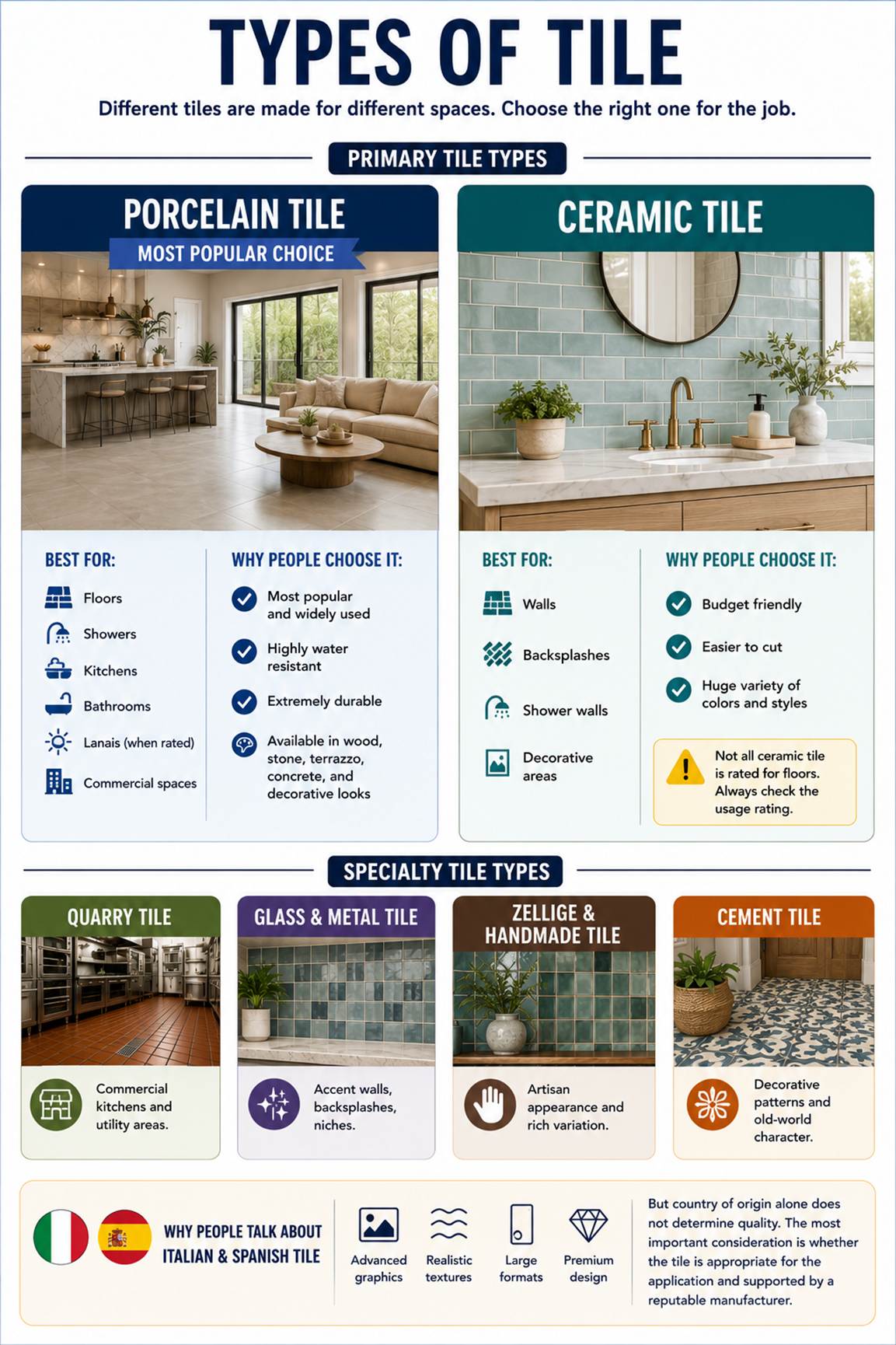
Porcelain tile is the most versatile and popular choice for floors. It is dense, durable, resistant to moisture, and suitable for nearly any residential application, including kitchens, bathrooms, living areas, lanais, and even some outdoor installations.
Ceramic tile is often a more budget-friendly option and works well for walls, backsplashes, and lighter-duty residential floors. It is generally easier to cut and install than porcelain.
Natural stone such as travertine, marble, slate, or limestone offers a unique, high-end appearance but typically requires more maintenance and sealing than porcelain or ceramic.
For most Hawaii homeowners, porcelain tile provides the best balance of durability, appearance, and long-term value.
What Tile Size Should I Choose?
Tile size has a major impact on the appearance of a room.
Large-format tile such as 12"x24", 24"x24", or larger creates a clean, modern appearance with fewer grout lines. Larger tiles can make many spaces feel more open and less visually busy.
Medium-sized tile remains a versatile option that works well in both traditional and contemporary homes.
Small-format tile and mosaics are commonly used in showers, accent walls, niches, and areas where additional slip resistance may be desired.
There is no universally "best" size. The right choice depends on the style of the home, the size of the room, and the overall design goals. Many homeowners today prefer larger formats because they provide a sleek, modern look with less grout maintenance.
Are Large-Format Tiles Harder or More Expensive to Install?
Often, yes.
Large-format tiles can create beautiful results, but they generally require more preparation and installation skill.
Large tiles demand:
- Flatter subfloors
- More precise installation techniques
- Specialized mortars and tools
- Additional attention to lippage control
- More planning around layouts and cuts
A poorly prepared floor that might work with smaller tile can become problematic when installing large-format tile. As tile sizes increase, labor costs may also increase due to the additional preparation and expertise required.
The finished appearance is often worth the investment, but homeowners should understand that installation quality becomes even more important with larger tile formats.
Is Tile Slippery When Wet?
Not all tile is slippery, but the finish you choose matters greatly.
Matte and textured tiles generally provide better traction and are often recommended for bathrooms, lanais, pool areas, and other locations that may become wet.
Polished or glossy tile can become very slippery when water is present and is typically better suited for walls rather than floors.
In fact, installing glossy tile on a floor can create a significant safety hazard, especially in bathrooms, entryways, outdoor areas, and homes with children, elderly family members, or pets. For most floor applications, we recommend choosing a matte finish or a tile specifically designed to provide slip resistance.
If slip resistance is a concern, ask about a tile's DCOF (Dynamic Coefficient of Friction) rating and where the manufacturer recommends it be used.
Does Tile Need to Be Sealed?
It depends on the type of tile.
Most porcelain tile does not require sealing. The surface is extremely dense and naturally resistant to moisture and staining.
Most glazed ceramic tile also does not require sealing.
Natural stone often benefits from periodic sealing to help resist staining and moisture intrusion. The maintenance requirements vary depending on the type of stone.
While the tile itself may not need sealing, some grout types can benefit from sealing, particularly in showers and wet areas. Many newer grout technologies offer improved stain resistance and may require little or no maintenance compared to traditional grout products.
Can Tile Be Used Outdoors in Hawaii?
Absolutely.
Porcelain tile is one of the best flooring materials available for Hawaii's climate. It is highly resistant to moisture, UV exposure, temperature fluctuations, and everyday wear.
For outdoor installations, homeowners should pay special attention to:
- Slip resistance
- Drainage
- Sun exposure
- Proper installation methods
- Expansion and movement considerations
Not all indoor tile is suitable for outdoor use, so it is important to select a product specifically rated for exterior applications.
Porcelain is commonly used on lanais, patios, walkways, pool decks, and outdoor living spaces throughout Hawaii because of its durability and low maintenance requirements.
Why Do Tile Installation Costs Vary So Much?
Many homeowners are surprised to learn that installation often costs more than the tile itself.
Several factors can dramatically affect the total cost of a tile project:
- Subfloor preparation and leveling
- Removal of existing flooring
- Waterproofing requirements
- Tile size and format
- Complex layouts and patterns
- Number of cuts and transitions
- Stairs, showers, and specialty details
- Tile material and thickness
For example, a simple straight-set floor using a standard porcelain tile may install much more affordably than a large-format tile floor requiring extensive leveling or a custom shower with waterproofing, niches, decorative accents, and intricate layouts.
The quality of the installation is just as important as the tile itself. A properly installed tile floor can last for decades, while shortcuts during preparation often lead to expensive problems later.


