

Residential Carpet in Hawaii
Carpet remains one of the most comfortable and inviting flooring choices available, offering warmth, softness, noise reduction, and a cozy feel that many hard-surface floors simply cannot match. Modern residential carpets are more durable, stain resistant, and family-friendly than ever before, making them a practical option for bedrooms, living spaces, playrooms, and other areas where comfort underfoot is a priority. Its combination of comfort, acoustical benefits, and design flexibility continues to make carpet a popular flooring choice for many homeowners.
At Paradise Flooring in Honolulu, we focus on high-quality carpet systems selected to perform well in Hawaii’s climate and lifestyle. We evaluate carpet based on fiber type, construction, stain resistance, appearance retention, indoor air quality, cushion compatibility, and long-term value. This guide explains how carpet is made, the differences between fiber types and styles, where carpet performs best, and what to consider when comparing products for your home.

Best Uses for Residential Carpet in Hawaii

How Residential Carpet Is Typically Constructed
Understanding how carpet is built helps explain why some carpets perform better in certain homes than others. Several components work together to determine comfort, durability, appearance retention, and overall value.

The Carpet Fiber (A) is the visible material you see and walk on every day. The best fiber depends on your priorities, including traffic levels, pets, stain concerns, comfort preferences, and budget. Pile construction refers to how the carpet yarn is tufted and finished. This has a major impact on both appearance and performance.
The Backing (B) forms the structural foundation of the carpet. It secures the fibers and helps maintain dimensional stability over time. High-quality backing contributes to stronger tuft bind, improved performance, and better long-term durability. While consumers rarely see the backing after installation, it plays an important role in how well a carpet performs throughout its lifespan.
The Carpet Cushion/Pad (C), is the support layer installed beneath stretch-in carpet. Cushion selection affects comfort, sound absorption, insulation, and overall carpet longevity. Many homeowners assume thicker is always better, but that is not necessarily true. An overly soft or excessively thick cushion can contribute to wrinkling, seam stress, and premature wear. The best approach is to select a cushion with the thickness and density recommended by the carpet manufacturer for the specific application. A properly matched cushion can significantly improve comfort while helping protect your carpet investment.
Carpet Fibers: What Matters Most
Fiber is one of the most important carpet decisions because it affects resilience, stain resistance, softness, color, price, and how the carpet ages in traffic lanes. There is no perfect fiber for every home. The best choice depends on how the room will be used. Solution-dyed carpet fibers lock color throughout the fiber itself rather than only on the surface, improving fade resistance and stain resistance.
| Fiber | Strengths | Watchouts / Best Uses |
|---|---|---|
| Nylon | Excellent resilience, strong texture retention, good performance in stairs, hallways, and for heavy traffic. | Usually costs more than polyester. Needs stain protection because nylon is more absorbent than some newer fibers. |
| Triexta / SmartStrand | Strong built-in stain resistance, popular for families and pets. Mohawk SmartStrand is a major example. | Great stain story, but compare density, twist, style, and traffic rating just like any carpet. For extreme traffic, premium nylon may still be preferred by some carpet experts. |
| PET Polyester / EverStrand | Very soft, strong color clarity, good stain resistance, often budget friendly. Mohawk EverStrand uses recycled plastic bottles in its PET fiber story. | Less resilient than nylon in heavy traffic, so it is usually better for bedrooms and moderate-use spaces unless construction is upgraded. |
| Olefin / Polypropylene | Very stain resistant and moisture resistant. Often used in loop, indoor-outdoor, or budget products. | Lower resilience and can crush or mat in traffic. Oily soils can be difficult. Not usually the first choice for premium residential broadloom. |
| Wool | Natural, luxurious, resilient, beautiful, and renewable. Often used in higher-end products from premium mills. | Higher cost. Can stain or be damaged by improper cleaning. Requires the right maintenance and is less common for budget residential projects. |
Mohawk and T&A Supply Carpet Options
Since Paradise Flooring primarily carries T&A Supply and Mohawk carpet, most residential selections will come from those programs. T&A Supply gives us access to practical carpet options through a strong regional distribution network serving Hawaii. Mohawk offers several major residential carpet fiber platforms, including SmartStrand and EverStrand, plus a broad range of styles, colors, and performance levels.
Mohawk SmartStrand
SmartStrand is Mohawk’s triexta-based carpet platform. Its biggest selling points are softness, built-in stain resistance, family-friendly cleanability, and pet-friendly performance. It is a strong option for bedrooms, family rooms, and homes with kids or pets, especially when paired with the right cushion and maintenance routine.
Mohawk EverStrand
EverStrand is Mohawk’s PET carpet platform made through its Continuum process using recycled plastic bottles. It is often a good fit for homeowners who want soft carpet, attractive color, stain resistance, and a sustainability story at a more approachable price point. As with other polyester carpets, construction and traffic level matter.
Premium Carpet: Fabrica, Dixie Home & Masland
For clients who want a more designer-driven carpet, we can also source premium options such as Fabrica, Dixie Home, and Masland. These lines often include higher-end nylon, wool, wool blends, patterns, tailored textures, and more sophisticated color palettes. They are especially useful for primary suites, custom homes, designer projects, stairs, offices, and statement rooms where style and hand feel matter as much as price.
Carpet Styles and Pile Types
Carpet style affects both appearance and performance. A carpet can be made from a strong fiber and still be the wrong choice if the style is too delicate for the room.

Carpet Specifications: Face Weight, Density, Twist, and Pile Height
No single carpet specification tells the whole story. A higher face weight does not automatically mean a better carpet because density, twist, pile height, fiber, and style all affect performance.
| Specification | Plain-English Meaning | Why It Matters |
|---|---|---|
| Face Weight | The weight of the carpet fiber only, not the backing. Usually shown in ounces per square yard. | Helpful, but often overused as a sales tool. Compare it together with density, pile height, twist, fiber, and style. |
| Pile Density | How closely the tufts are packed together. It relates face weight to pile height. | Dense carpet tends to resist matting and crushing better, especially in traffic lanes. |
| Twist | How tightly individual yarns are twisted together. | Better twist helps the yarn hold its shape and resist fraying or blooming. It is especially important in cut pile carpet. |
| Pile Height | How tall the yarn stands above the backing. | Taller carpet can feel soft but may crush more easily if not dense enough. Low pile is often better for stairs and heavy traffic. |
| Tuft Bind | How securely the yarn is held in the backing. | Important for durability, stairs, seams, and preventing tufts from pulling out. |
| Warranty Terms | Manufacturer coverage for wear, texture retention, stains, soil, pets, manufacturing defects, and installation requirements. | Read what is actually covered. Appearance change, matting, exclusions, and maintenance requirements matter. |
A practical rule: for heavy traffic, prioritize resilient fiber, dense construction, good twist, lower to moderate pile height, and the correct cushion. For bedrooms, softness and color may matter more, and a softer PET or triexta carpet can be a good value. Face weight is one of the most misunderstood carpet specifications because it only measures fiber weight, not construction quality. A heavy carpet with low density or poor twist may still perform poorly.
Carpet Cushion and Pad
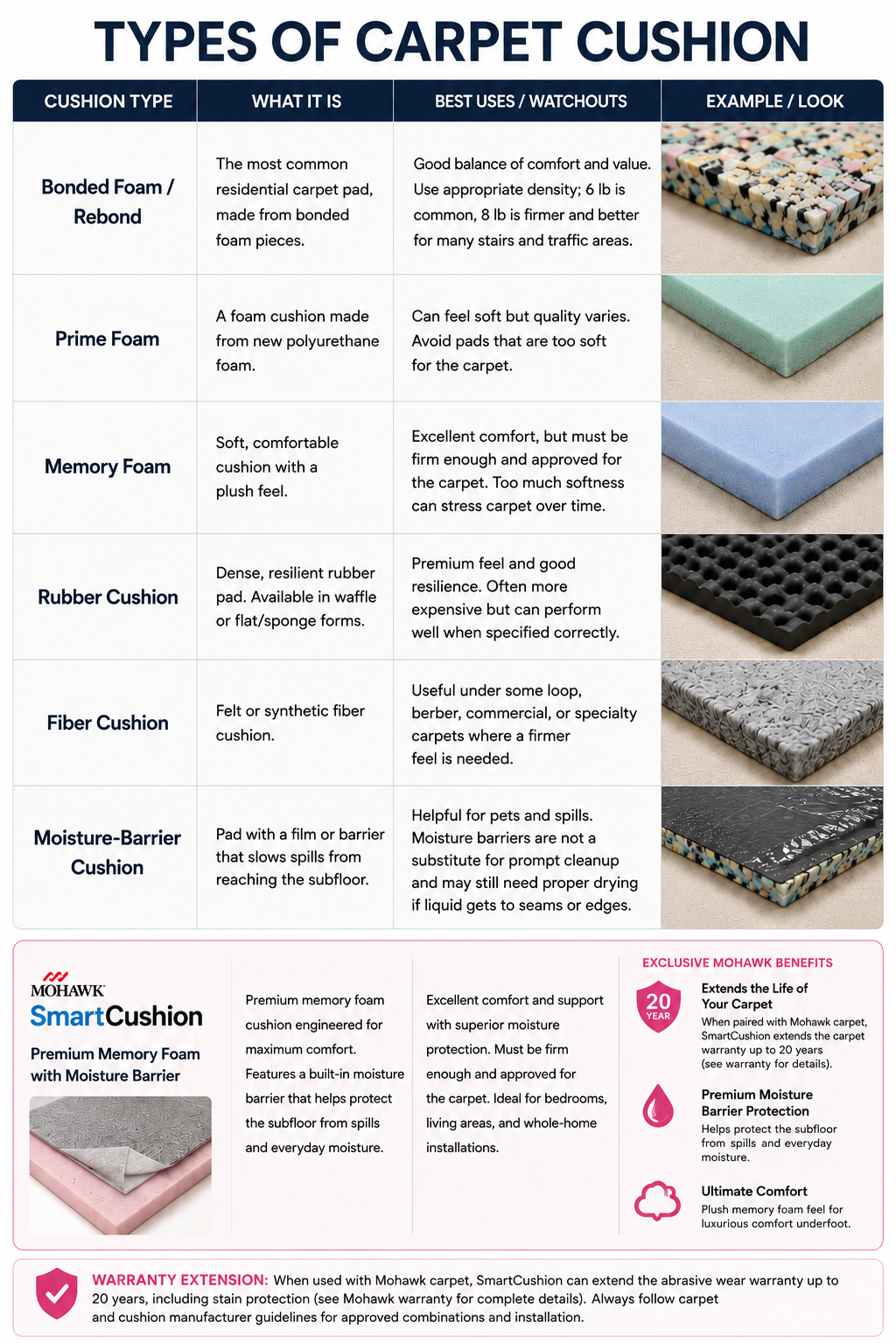
Carpet cushion is the foundation of a stretch-in carpet installation. It affects comfort, acoustics, insulation, appearance retention, and the way the carpet flexes underfoot. The wrong cushion can make a good carpet perform poorly.
For many residential cut-pile carpets, a common guideline is cushion no thicker than 7/16 inch and no thinner than 1/4 inch with at least 6 pounds per cubic foot density. For berber or low-profile carpet, a thinner and firmer pad is often recommended, commonly no more than 3/8 inch thick with 8-pound density. Always follow the carpet manufacturer’s requirements because warranties may depend on the approved cushion.
Mohawk SmartCushion
Mohawk SmartCushion is a premium memory foam carpet cushion designed for comfort, spill protection, and pet-friendly performance. Mohawk describes it as a sustainable cushion made with recycled materials, with a moisture barrier and All Pet protection to help repel liquid spills and reduce common pet odors. When paired with qualifying Mohawk carpet, SmartCushion can also enhance or extend certain Mohawk warranty coverages. SmartCushion is not just about softness. It can be a smart upgrade when the home has pets, kids, bedrooms where comfort matters, or a Mohawk carpet where the warranty benefit is valuable. For stairs, low-profile carpet, or patterned products, confirm the proper thickness and density before choosing the pad.
Installation Considerations
Carpet installation is not a DIY-friendly project and is usually best left to experienced professional installers. Proper installation requires specialized tools, seam planning, stretching equipment, and installation techniques that directly affect long-term performance. Carpet also has directional shading and pile lay, which can affect how light reflects across the room. Large open areas, hallways, adjoining rooms, and patterned carpets should be carefully planned before installation.

Carpet on Stairs
Stairs are one of the toughest areas for carpet because every step concentrates pressure on the stair nose. This is where fiber resilience, density, twist, backing, cushion firmness, and installer skill matter most. A carpet that works well in a bedroom may not be ideal for a main staircase.
For stairs, look for a dense, resilient carpet with good twist and a firm cushion. Nylon, premium triexta, dense frieze, tight textures, and certain patterned carpets can work well. Very soft, tall, loose, or low-density carpets may crush faster on stair nosings. Patterned carpet can look beautiful on stairs, but pattern alignment and installation labor should be discussed before ordering.
Sustainability and Indoor Air Quality
Carpet sustainability depends on fiber type, recycled content, manufacturing, durability, maintenance, and end-of-life options. Mohawk EverStrand is a strong sustainability story because it uses recycled plastic bottles to make PET carpet fiber. SmartStrand also uses partially renewable bio-based content in its triexta fiber platform. Wool is natural and renewable, but it comes at a higher price point and needs appropriate maintenance.
For indoor air quality, look for carpet and cushion with recognized emissions certifications such as CRI Green Label Plus or manufacturer documentation. At Paradise Flooring, we only offer products that meet recognized indoor air quality and emissions standards.
Living With Carpet: Maintenance, Pets, Kids, and Allergies
Modern residential carpet is much easier to maintain than many homeowners expect, but no carpet is completely stain-proof or maintenance-free. The best-performing installations combine the right carpet fiber, stain protection technology, and cushion system to create a floor that is comfortable, durable, and easy to care for.
For homes with children and pets, built-in stain resistance and cleanability should be priorities. Products such as Mohawk SmartStrand are popular because the stain resistance is built directly into the fiber rather than applied as a surface treatment. Pairing a quality carpet with a moisture-resistant cushion such as Mohawk SmartCushion can help address pet accidents, spills, odors, and everyday family use. Even with the best products, accidents should be cleaned promptly. Pet urine should never be cleaned with hot water or steam because heat can permanently set stains and odors.
Routine maintenance is straightforward. Regular vacuuming removes dry soil before it becomes embedded in the carpet. In Hawaii, homes near the beach may require more frequent vacuuming since sand can act like an abrasive and accelerate wear. For spills, blot rather than scrub and follow manufacturer cleaning recommendations. Aggressive scrubbing or excessive moisture can damage carpet fibers and backing over time. Carpet can also be a good option for allergy-sensitive households. Unlike hard surfaces that allow dust and particles to remain airborne, carpet can trap those particles until they are removed through vacuuming. The key is consistent maintenance, a quality vacuum, and periodic professional cleaning.
All carpet gradually changes appearance with use. One of the most important performance characteristics is texture retention, which refers to how well the carpet maintains its original appearance instead of matting, crushing, or developing traffic patterns. Higher-quality fibers and constructions typically perform better over time.
Periodic professional cleaning helps maintain appearance and extend carpet life. Many carpet warranties also require professional hot-water extraction cleaning at specified intervals, so homeowners should keep cleaning receipts and maintenance records in case a warranty claim is ever needed.

Common Mistakes When Buying Carpet
- Choosing based only on softness. The softest carpet is not always the most durable carpet. A carpet with poor density, weak twist, or the wrong cushion may flatten or wear prematurely even if it initially feels very plush.
- Assuming higher face weight automatically means better quality. Density, twist, pile height, and fiber matter just as much.
- Using a pad that is too thick or too soft. This can cause wrinkles, seam stress, and premature wear.
- Putting bedroom-grade carpet on stairs or hallways without checking traffic performance.
- Not reading warranty requirements for cushion, installation, vacuuming, and professional cleaning.
- Choosing loop carpet in a home with pets that may snag the loops.
- Waiting too long to clean spills or using the wrong cleaner.

Why Buy from Paradise Flooring
At Paradise Flooring, we take an educational and consultative approach to flooring selection. We help customers compare flooring and select the right products based on their project-specific needs, not just marketing claims or showroom trends.
Our showroom features carefully selected products from reputable manufacturers chosen for their value, quality, performance, and suitability for Hawaii’s unique climate and lifestyle.
We hope this Buyer’s Guide has helped you better understand Residential Carpet the important factors to consider when selecting a floor for your home or project. If you still have questions or would like help comparing options, please don’t hesitate to call, visit our showroom, or speak with our team for product guidance, samples, estimates, and installation recommendations.
Frequently Asked Questions
What is the best carpet for homes with kids and pets?
The best carpet for homes with kids and pets is one that balances stain resistance, cleanability, durability, comfort, and the right cushion underneath. No carpet is completely stain-proof or maintenance-free, but modern residential carpet is much easier to live with than many homeowners expect.
For active households, we usually recommend looking at carpets with built-in stain resistance, strong texture retention, and fibers that can handle everyday traffic. Mohawk SmartStrand is a popular option because its stain resistance is built into the fiber itself, making it a strong choice for spills, pet accidents, and family living. Premium nylon is another excellent option, especially in areas where long-term resilience and resistance to crushing are top priorities.
The carpet cushion matters too. For homes with pets or young children, a moisture-resistant cushion such as Mohawk SmartCushion can help prevent spills and accidents from soaking deeper into the cushion. This can make cleanup easier and help reduce odor concerns.
The key is to choose the carpet and cushion as a system, not as separate pieces. A soft carpet with the wrong pad may not perform as well, while a properly matched carpet and cushion can feel better, last longer, and be easier to maintain.
Which carpet fiber is best?
There is no single best carpet fiber for every home. The best choice depends on how the room will be used, how much traffic it gets, whether there are pets or children, and what matters most: durability, softness, stain resistance, appearance, or budget.
Nylon is often considered the benchmark for durability and resilience. It is especially good in high-traffic areas because it tends to recover well from foot traffic and furniture pressure. If appearance retention is the top priority, premium nylon is usually one of the strongest choices.
Triexta, commonly known through Mohawk SmartStrand, is known for softness and excellent built-in stain resistance. It is a strong option for family homes, pets, bedrooms, and living areas where comfort and cleanability are important.
Polyester is usually soft, stain-resistant, and budget-friendly. It can be a good choice for lower-traffic rooms or homeowners who want a soft feel at a more affordable price. However, it may not have the same long-term resilience as premium nylon in heavy-traffic areas.
Olefin is more common in loop, commercial, or specialty carpet styles. It is moisture-resistant and colorfast, but it is generally not the best choice for plush residential carpet in heavy-use areas.
Wool is a premium natural fiber with a beautiful look and feel. It has natural resilience and warmth, but it is typically more expensive and may require more careful maintenance than synthetic fibers.
For most homeowners, the decision usually comes down to premium nylon versus SmartStrand/triexta. Nylon is often best for maximum resilience and heavy traffic. SmartStrand is often best for softness, stain resistance, and family-friendly cleanability.
How stain-resistant is modern carpet?
Modern carpet can be very stain-resistant, especially compared with older carpet, but it is important to have realistic expectations. Stain-resistant does not mean stain-proof. The carpet fiber, stain protection technology, color, construction, and maintenance habits all affect how well a carpet handles spills.
Some carpets use topical stain treatments that help repel spills and make cleanup easier. Others, such as Mohawk SmartStrand, have stain resistance built into the fiber itself. Solution-dyed fibers can also provide strong colorfastness because the color runs through the fiber rather than being applied only to the surface.
For everyday spills, quick response is still important. Blot the spill instead of scrubbing, use manufacturer-recommended cleaners, and avoid harsh chemicals that can damage the fiber or void the warranty. With pet accidents, avoid hot water or steam at first because heat can set odor and stain problems.
Carpet color also matters. Very light carpet can show stains more easily, while very dark carpet can show lint, dust, and contrast from light-colored debris. Mid-tone colors, subtle flecks, and textured patterns are often more forgiving for busy households.
The best stain protection comes from combining the right fiber, the right carpet style, the right cushion, and proper cleaning habits.
Will carpet show footprints and vacuum marks?
Some carpets show footprints and vacuum marks more than others. This is not always a defect. It is often a normal characteristic of certain carpet styles, especially soft, smooth, plush carpets.
Plush and velvet-style carpets have a smooth, uniform surface. This gives them a clean and luxurious appearance, but it also means the pile direction changes more visibly when walked on or vacuumed. That change in direction can create lighter and darker areas, sometimes called shading or pooling.
Textured carpets, frieze styles, patterned carpets, and carpets with more variation in the yarn tend to hide footprints and vacuum marks better. These styles are often more practical for active homes because they disguise everyday use more effectively.
If a homeowner wants a formal, elegant look, a plush carpet can be beautiful. If they want something more casual, forgiving, and easy to live with, a textured or patterned carpet is usually a better fit.
This is why it is important to view carpet samples in person and think about how the room will actually be used. The carpet that looks the smoothest on a sample board may not be the easiest to live with in a busy household.
Will carpet mat down or flatten over time?
All carpet changes appearance with use, but better carpet should resist matting, crushing, and traffic patterns longer than lower-quality carpet. This is often described as texture retention, which means how well the carpet maintains its original look and feel over time.
Matting and flattening are influenced by several factors: fiber type, yarn twist, density, pile height, construction, cushion, traffic level, and maintenance. A carpet with poor density, low twist, or overly tall soft fibers may feel great at first but can show wear faster in busy areas.
Nylon is generally strong for resilience because it tends to recover well from compression. SmartStrand/triexta also performs well in many residential settings, especially when paired with the right construction and cushion. Polyester can be very soft and stain-resistant, but in high-traffic areas, it may be more prone to crushing than premium nylon.
The cushion underneath also affects performance. A pad that is too soft or too thick can allow too much movement, which can contribute to wrinkling, seam stress, and premature wear. The correct cushion should support the carpet without making it unstable.
Regular vacuuming also matters. Dry soil, dust, and sand can grind into the yarn and backing, acting like an abrasive. In Hawaii, homes near the beach may need more frequent vacuuming because sand can accelerate wear.
Is carpet a good choice for people with allergies?
Carpet can be a good choice for many allergy-sensitive households when it is maintained properly. A common misconception is that carpet automatically makes allergies worse. In reality, carpet can trap dust, pollen, pet dander, and other particles until they are removed through vacuuming, rather than allowing them to stay airborne and circulate around the room.
The key is maintenance. A good vacuum with strong filtration, regular vacuuming, and periodic professional cleaning are important. Homes with pets, open windows, or beach sand may need more frequent cleaning. Carpet can also make a room feel softer, quieter, and more comfortable, which is one reason many homeowners still prefer it in bedrooms, stairs, nurseries, and family spaces.
For allergy-sensitive customers, it is also worth considering the full flooring system. That includes the carpet, cushion, adhesives if used, and indoor air quality certifications. Many modern carpets are designed with low emissions in mind, but homeowners should still ask about product certifications and manufacturer recommendations.
Carpet is not the right answer for every allergy situation, especially if someone has severe sensitivities or cannot maintain it regularly. But for many households, a quality carpet with proper maintenance can be comfortable, clean, and practical.
How long should carpet last?
Carpet lifespan depends on the quality of the carpet, the fiber, the construction, the cushion, the amount of traffic, the household lifestyle, and how well it is maintained. A lightly used bedroom carpet may last much longer than the same carpet installed on stairs or in a busy hallway.
As a general guideline, budget carpet may be suitable for short-term use or lower-traffic areas, but it may show wear faster. Mid-range carpet can perform well for many homes when properly selected and maintained. Premium carpet with better fiber, density, twist, backing, and cushion can provide better long-term appearance retention and comfort.
Traffic matters a lot. Stairs, hallways, family rooms, and main bedrooms usually experience more wear than guest rooms or formal spaces. Pets, children, shoes, beach sand, rolling chairs, and heavy furniture can also affect performance.
Maintenance is a major factor. Regular vacuuming, quick spill cleanup, and periodic professional cleaning can help extend the life of the carpet. Many manufacturers also require professional cleaning at specific intervals to keep warranties valid, so homeowners should keep receipts and maintenance records.
A good carpet should not be judged only by how it feels on day one. It should be judged by how well it keeps its appearance over time.
How do I keep my carpet looking new?
The most important step is regular vacuuming. Vacuuming removes dry soil before it works its way into the carpet and acts like sandpaper against the fibers. In Hawaii, this is especially important for homes near the beach, where sand can be tracked indoors.
Spills should be handled quickly. Blot the spill with a clean towel instead of scrubbing. Scrubbing can distort the fibers and spread the stain. Use manufacturer-recommended or CRI-approved cleaning products, and avoid harsh chemicals that may damage the carpet or void the warranty.
For pet accidents, clean promptly and avoid heat at the beginning of the cleaning process. Hot water or steam can set urine odors and stains, making them harder to remove.
Use walk-off mats at entrances, remove shoes when practical, and rotate furniture when possible to reduce uneven wear. For rooms with heavy use, choosing a more forgiving carpet style from the beginning can make a big difference.
Professional cleaning is also important. Many carpet warranties require hot-water extraction cleaning at regular intervals. Even when it is not required, periodic professional cleaning helps remove deeper soil and refresh the carpet’s appearance.
The best results come from choosing the right carpet for the home and then maintaining it consistently. A durable, family-friendly carpet with the right cushion and regular care will look better, feel better, and last longer.


