


Loose Lay Vinyl Flooring in Hawaii
Loose Lay vinyl flooring (sometimes just referred to as “Looselay”) has become increasingly popular because it combines the modular repairability of glue-down flooring with the comfort and installation simplicity of floating floors. Many loose lay products feel softer, quieter, and more substantial underfoot while still offering excellent waterproof performance and dimensional stability. This balance of comfort, practicality, and serviceability makes loose lay flooring especially attractive for modern residential and light commercial spaces.
At Paradise Flooring in Honolulu, we carefully evaluate loose lay flooring systems based on dimensional stability, acoustic performance, serviceability, comfort underfoot, and long-term installation reliability. Loose lay flooring can provide an excellent balance between modular repairability and installation flexibility when properly specified. This guide explains how loose lay flooring is constructed, where it performs best, and how it compares to click-lock and glue-down flooring systems.

Best Uses for Loose Lay Flooring in Hawaii

How Loose Lay Flooring Is Constructed

Wear Layer (A)
The Wear Layer (A) protects the decorative film and is commonly available in commercial-grade thicknesses designed for both residential and light commercial applications. Embossing creates texture that simulates real wood grain or stone surfaces. Premium products may feature embossed-in-register texture that aligns the texture with the printed grain pattern for greater realism.
A polyurethane Protective Coating protects the surface from everyday wear. Some manufacturers incorporate ceramic bead or aluminum oxide additives to improve scratch resistance. Certain manufacturers, such as Karndean, also offer systems that allow the polyurethane coating to be refreshed or restored over time, extending the floor’s appearance and service life.
Decorative Film (B)
The Decorative Film (B) provides the visual design. Higher-quality loose lay floors typically feature sharper visuals, improved image clarity, reduced pattern repetition, and realistic wood or stone visuals.
Stability Layer (C)
The Vinyl Stability Layer (C) provides mass, dimensional stability, and comfort underfoot. Loose lay products are often thicker and heavier than traditional glue-down vinyl, which contributes to improved acoustic performance and a softer feel when walking on the floor.
Backing Layer (D)
The Backing Layer (D) is one of the defining characteristics of loose lay flooring. Most products use a high-friction backing designed to grip the substrate and reduce movement. This allows the floor to stay in place without relying on a click-lock mechanism.
How Loose Lay Flooring Is Installed
Loose lay flooring is one of the most flexible resilient flooring systems available. Small rooms can sometimes be installed using a pressure-fit installation, but usually installers will glue the perimeter and larger spaces are commonly installed using a perimeter adhesive and grid-stick method to keep the floor stable while maintaining modular repairability. In higher-traffic environments, tighter grid spacing or even full-spread adhesive may be used.

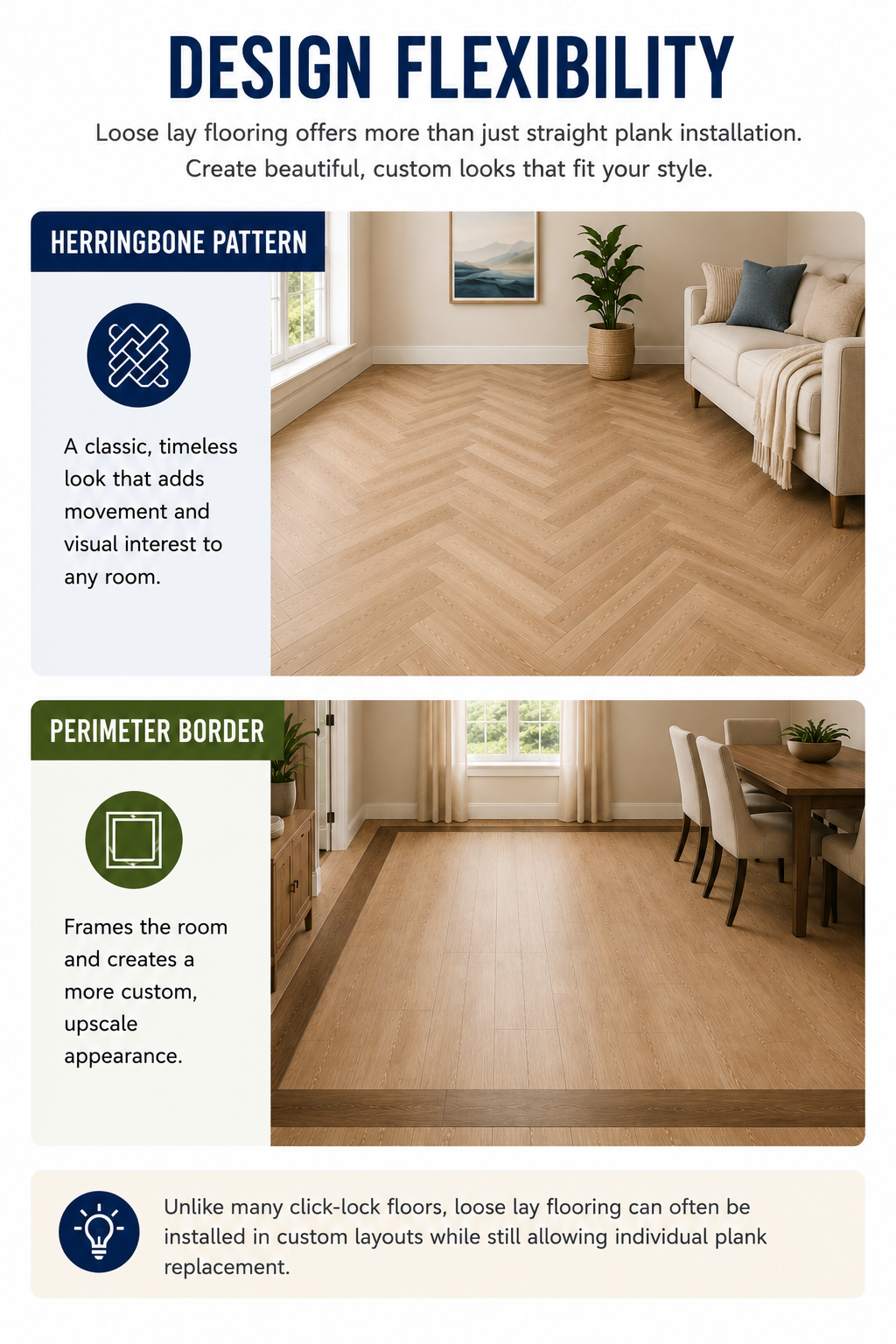
Loose lay flooring also offers exceptional layout flexibility. Unlike many click-lock floors that are constrained by locking-system geometry and installation requirements, loose lay products can often be installed in herringbone patterns, perimeter borders, feature areas, mixed-width layouts, and other custom designs. This gives homeowners and designers more freedom to create unique flooring layouts without sacrificing the modular repairability that is one of loose lay flooring's biggest advantages.
Since loose lay flooring is installed directly against the substrate, the seams are extremely tight when properly installed. Everyday spills, pet accidents, tracked-in rainwater, and routine cleaning are generally not concerns for the flooring itself. When properly installed, water should not easily penetrate between planks under normal residential use. Like all resilient flooring systems, loose lay flooring is considered topically waterproof rather than flood proof. Catastrophic flooding or prolonged standing water beneath the floor may still require removal and drying of the affected area.
Like any flooring system, proper subfloor preparation remains important. Concrete slabs may require moisture mitigation, while wood subfloors may need patching or leveling to ensure a smooth finished appearance. The specific preparation requirements depend on the project, substrate, and site conditions.
When properly installed, loose lay flooring creates a stable, durable, and serviceable floor that combines many of the advantages of both glue-down and floating flooring systems.
How Loose Lay Compares to Click and Gluedown Flooring
Loose lay flooring occupies a unique middle ground between click-lock floating floors and traditional glue-down vinyl.
Compared to click-lock flooring, loose lay often feels more solid underfoot, can be quieter to walk on, and does not depend on a mechanical locking system. This eliminates one of the most common long-term concerns with floating floors: locking-system fatigue or joint separation.
Compared to traditional glue-down flooring, loose lay offers many of the same benefits, including excellent stability and modular plank replacement, while simplifying repairs and reducing installation complexity.
The biggest advantage of loose lay flooring is serviceability. If a plank becomes damaged, individual planks can often be lifted and replaced without removing large sections of surrounding flooring. This modular repairability is one reason loose lay flooring is popular in rental properties, commercial spaces, condominiums, and homes where long-term maintenance flexibility is important.
Many loose lay products are also thicker than traditional glue-down flooring, which can provide:
- Improved acoustic performance
- A quieter feel underfoot
- Greater comfort when walking
- Better forgiveness over minor subfloor imperfections
For many projects, loose lay flooring delivers the stability and repairability of glue-down flooring with much of the simplicity and flexibility associated with floating floors.
Common Mistakes When Buying Loose Lay Flooring
Choosing loose lay flooring based only on price is one of the most common mistakes. Lower-cost products may reduce product weight, backing quality, dimensional stability, or wear-layer quality to achieve lower pricing.
Another common mistake is treating loose lay flooring as if it requires no subfloor preparation. While loose lay systems are modular and flexible, they still require proper substrate preparation to perform correctly.
Using the wrong installation method for the environment can also create problems. Small residential rooms may perform perfectly with perimeter and grid-stick installations, while higher-traffic commercial areas may require tighter grid spacing or full-spread adhesive installations.
Finally, it is important to work with experienced flooring professionals who understand how environmental conditions, sunlight exposure, traffic levels, and substrate conditions affect resilient flooring performance over time.

Why Buy From Paradise Flooring
At Paradise Flooring, we take an educational and consultative approach to flooring selection. We help customers compare flooring and select the right products based on their project-specific needs, not just marketing claims or showroom trends.
Our showroom features carefully selected products from reputable manufacturers chosen for their value, quality, performance, and suitability for Hawaii’s unique climate and lifestyle.
We hope this Buyer’s Guide has helped you better understand Loose Lay flooring and the important factors to consider when selecting a floor for your home or project. If you still have questions or would like help comparing options, please don’t hesitate to call, visit our showroom, or speak with our team for product guidance, samples, estimates, and installation recommendations.
Frequently Asked Questions
Is loose lay flooring waterproof? Can't water get through the seams?
Like other vinyl floors, loose lay flooring is considered topically waterproof, meaning the flooring itself is not damaged by everyday spills, pet accidents, tracked-in rainwater, or routine cleaning. When properly installed, the seams are extremely tight and surface water should not penetrate between planks.
Like any flooring system, however, loose lay flooring is not designed to handle catastrophic flooding or prolonged standing water trapped beneath the floor. If a major leak or flood occurs, portions of the floor may need to be removed so the substrate can properly dry.
For everyday living, loose lay flooring offers excellent moisture performance and is well suited for kitchens, living areas, rental properties, and active households.
Is loose lay flooring good for homes with pets?
Yes. Loose lay flooring performs exceptionally well in homes with pets because it is durable, easy to clean, resistant to everyday moisture, and quieter underfoot than many hard-surface flooring options.
Pet claws, water bowls, mud, and the occasional accident are all part of everyday life. Loose lay flooring handles these situations very well, and one of its biggest advantages is that if a plank becomes heavily scratched, gouged, or damaged, individual planks can often be replaced without removing large sections of surrounding flooring.
Many pet owners appreciate the fact that loose lay combines durability with long-term repairability.
Does loose lay flooring scratch easily?
Loose lay flooring is scratch resistant, but no hard-surface floor is completely scratch proof. Floors with high-quality polyurethane coatings and commercial-grade wear layers generally provide the best long-term durability.
As with any flooring, using felt pads under furniture, keeping pet nails trimmed, and reducing sand and debris tracked into the home will help preserve the appearance of the floor.
The good news is that loose lay flooring offers something many other flooring categories do not: easy plank replacement. If a scratch, gouge, or stain does occur and becomes objectionable, individual planks can often be replaced without disturbing large areas of surrounding flooring. That repairability is one of the category's biggest advantages and one reason loose lay is popular in homes, rentals, offices, and commercial environments.
How do you replace damaged loose lay planks?
One of the biggest advantages of loose lay flooring is modular plank replacement.
In many cases, a damaged plank can simply be lifted and removed without disassembling large sections of surrounding flooring. A replacement plank is then installed in its place.
Depending on the installation method and age of the floor, the installer may apply a small amount of fresh adhesive beneath the replacement plank or along the affected area to restore the original bond. After placement, the area is typically rolled or firmly pressed to ensure proper contact and a smooth appearance.
This process is often significantly easier than repairing click-lock flooring and is one of the primary reasons loose lay flooring is frequently specified for rental properties, commercial offices, healthcare environments, retail spaces, and other locations where long-term maintenance flexibility is important.
Keeping a few extra planks from the original installation is always recommended.
Does loose lay flooring require more floor preparation than click-lock LVP?
Not necessarily. Both flooring systems require proper subfloor preparation to achieve the best long-term results.
Loose lay flooring performs best over clean, flat, smooth, and properly prepared substrates. Because the flooring sits more directly against the substrate, significant imperfections can sometimes telegraph through the finished floor.
That said, one advantage of loose lay flooring is that minor issues can often be corrected after installation. If a plank corner develops slight lippage or movement, the installer can frequently lift the affected area, apply a small amount of adhesive, press the plank back into place, and roll it. This simple repair often resolves the issue without requiring major disassembly.
Concrete slabs should always be moisture tested prior to installation, and wood subfloors may require patching or leveling where abrupt changes in elevation exist. The exact preparation requirements depend more on the condition of the substrate than on the flooring category itself.
Can loose lay flooring be installed in condominiums?
Yes. Loose lay flooring is commonly used in condominiums because its thicker construction often provides improved acoustic performance compared to traditional glue-down flooring.
Many homeowners also prefer the quieter, more solid feel underfoot compared to some floating click-lock floors. However, acoustic performance depends on the complete flooring assembly, including the substrate, adhesive method, and any required sound-control underlayments.
Always review your building's flooring requirements before installation, as condominium associations may have specific acoustic standards that must be met.
Why would I select loose lay instead of click-lock vinyl?
Loose lay flooring offers several advantages over traditional click-lock flooring.
The biggest difference is serviceability. If a plank becomes damaged, individual planks can often be lifted and replaced without disassembling large sections of flooring. This modular repairability is one of the category's strongest selling points.
Loose lay flooring also:
- Eliminates dependence on a mechanical locking system
- Avoids concerns about locking-system fatigue or joint separation
- Often feels more solid underfoot
- Can be quieter when walked on
- Is frequently easier to repair
- Allows greater layout flexibility, including herringbone patterns, borders, and custom designs
For homeowners, rental properties, offices, retail spaces, and other environments where future repairs are a consideration, loose lay flooring offers a level of maintenance flexibility that click-lock floors often cannot match.
Why would I select loose lay instead of glue-down vinyl?
Loose lay flooring occupies a unique middle ground between click-lock and traditional glue-down flooring.
It provides many of the stability and repairability advantages of glue-down flooring while simplifying repairs and reducing installation complexity. Many loose lay products are also thicker than traditional glue-down floors, which can provide a quieter and more comfortable feel underfoot.
Compared to traditional glue-down flooring, loose lay often offers:
- Easier plank replacement
- Simpler future repairs
- Improved acoustics
- Greater comfort underfoot
- More flexibility for renovations or layout changes
For many residential and light commercial projects, loose lay delivers much of the performance of a glue-down floor while maintaining the modular repairability that makes the category so attractive.


