

Laminate Flooring in Hawaii
Modern laminate flooring has become one of the most practical and high-performing flooring options for busy households. Today’s premium laminate floors offer highly realistic wood visuals along with exceptional scratch resistance, dent resistance, fade resistance, and easy maintenance. Many homeowners are drawn to laminate because it delivers the warm appearance and solid feel of hardwood while handling pets, kids, heavy traffic, and everyday life remarkably well.
At Paradise Flooring in Honolulu, we carefully curate laminate flooring collections that combine realistic visuals with the durability required for Hawaii living. We evaluate laminate flooring based on locking systems, moisture resistance, scratch resistance, wear-layer durability, core quality, dimensional stability, and long-term performance in humid island environments. This guide explains how modern laminate.

Best Uses for Laminate Flooring in Hawaii

How Laminate is Typically Constructed


The Wear Layer
The Wear Layer (A) is typically a hard aluminum oxide coating to provide superior scratch and abrasion resistance. Scratch resistance is measured by the AC rating (Abrasion Class) rating. Common ratings include:
- AC3 – typical residential use
- AC4 – heavy residential or light commercial
- AC5 – heavy commercial environments
A high-resolution printed Decorative Film (B) is beneath the wear layer. Premium options have sharper more unique visuals less pattern repeats, and Embossed in-Register (EIR) technology to align the surface texture with the wood grain for a truly authentic appearance. Some floors even feature a thin veneer of real wood in lieu of the printed image.
The structural Core (C) is typically High Density Fiberboard (HDF). Unlike Medium Density Fiberboard (MDF), HDF is produced by compressing wood fibers under high pressure to create a dense, stable panel that resists dents and moisture intrusion.

Locking Systems
Well engineered Locking Systems (D) systems like Valinge® or Unilin® keep planks tightly connected while allowing the floor to expand and contract naturally. Today's water-resistant laminates feature waxed joints to prevent water intrusion at the seams.

Underlayment Pad
Laminate is installed over an Underlayment Pad (E) made of IXPE foam, rubber, or cork to reduce sound and absorb minor subfloor imperfections. For more information, see our Flooring Acoustics Blog Article.
Newer laminate designs have also introduced hybrid constructions with mineral-reinforced cores that improve water resistance and dimensional stability. These products combine laminate’s extremely durable aluminum-oxide wear surface with a more moisture-resistant core. Some hybrid laminates are also thinner and easier to install—similar to luxury vinyl plank—while still maintaining laminate’s exceptional scratch resistance.

Sustainability and Environmental Benefits
Laminate flooring offers one of the strongest environmental profiles in the hard-surface flooring category because it is PVC-free and primarily made from natural wood fibers rather than petroleum-based plastics. Most laminate cores are manufactured using recycled wood byproducts from sawmills, including sawdust, wood chips, and residual wood fiber that would otherwise go unused. This efficient “cascade use” of wood helps maximize natural resources while reducing manufacturing waste.
Laminate flooring also has a relatively low carbon footprint compared to many heavily processed flooring materials. Because it is primarily wood-based, laminate stores carbon during its service life and contains significantly less PVC and petroleum-based material than many resilient flooring products. Many laminate products are also biodegradable at the end of their usable life, unlike many plastic-based flooring materials.

Its highly wear-resistant surface helps reduce the need for frequent replacement, lowering long-term material consumption over the life of the floor. Many laminate manufacturers also source wood from responsibly managed forests certified by organizations such as Forest Stewardship Council (FSC®) or Programme for the Endorsement of Forest Certification (PEFC®), helping support long-term forest sustainability and responsible harvesting practices.
Compared to many resilient flooring products, laminate can also be a healthier indoor flooring option because it does not contain PVC, phthalates, or many of the plasticizers commonly associated with vinyl flooring.
High-quality laminate products are manufactured to strict indoor air quality standards with very low VOC emissions, contributing to healthier indoor environments for homes, schools, and commercial spaces. Many products carry independent certifications such as FloorScore® or GREENGUARD Gold, which verify compliance with rigorous VOC emission standards. At Paradise Flooring, if a product does not meet recognized indoor air quality and emissions standards, you simply will not find it in our showroom.
Installation Considerations
Laminate flooring is typically installed as a floating click-lock floor, meaning the planks connect to each other rather than being glued to the subfloor.
The locking system plays an important role in long-term performance. Well-engineered locking systems prevent water penetration and allow the floor to remain tightly connected while still accommodating natural expansion and contraction.
Since laminate planks contain wood fiber, they are usually cut using a sliding miter saw or heavy duty guillotine cutter. Installers often cut planks outside or in a garage rather than inside the living space. As a result, laminate installation can sometimes take slightly longer than luxury vinyl installations that use score-and-snap cutting methods.
Expansion gaps are required around the perimeter of the floor, and transitions may be necessary in very large spaces.

What to Look for When Buying Laminate Flooring
Laminate flooring has seen a recent resurgence in popularity as manufacturers have improved moisture resistance, visual realism, and locking technology. Many homeowners are rediscovering laminate because it offers several advantages over vinyl flooring, including:
- extremely durable aluminum oxide wear surfaces
- strong scratch resistance
- realistic wood visuals
- PVC-free construction
Modern laminate planks commonly range from 7–9 inches wide. Edge details such as micro-bevels or painted bevels help define individual boards and create a more authentic plank appearance. Higher-quality laminates often use Embossed-in-Register (EIR) technology, where the surface texture aligns with the printed wood grain pattern for greater realism. Matte or low-sheen finishes also tend to look more natural and hide minor wear better than high-gloss surfaces.
Once the visual style is selected, the structural components determine long-term performance. Core density is especially important. HDF cores provide greater strength and moisture resistance than lower-density MDF products.
Locking system quality also matters. Proven systems such as Valinge® or Unilin® create stronger plank connections and reduce the risk of joint separation over time. Buy from a reputable manufacturer and verify it has 3rd party air quality certifications.

Water Resistance and “Waterproof” Laminate
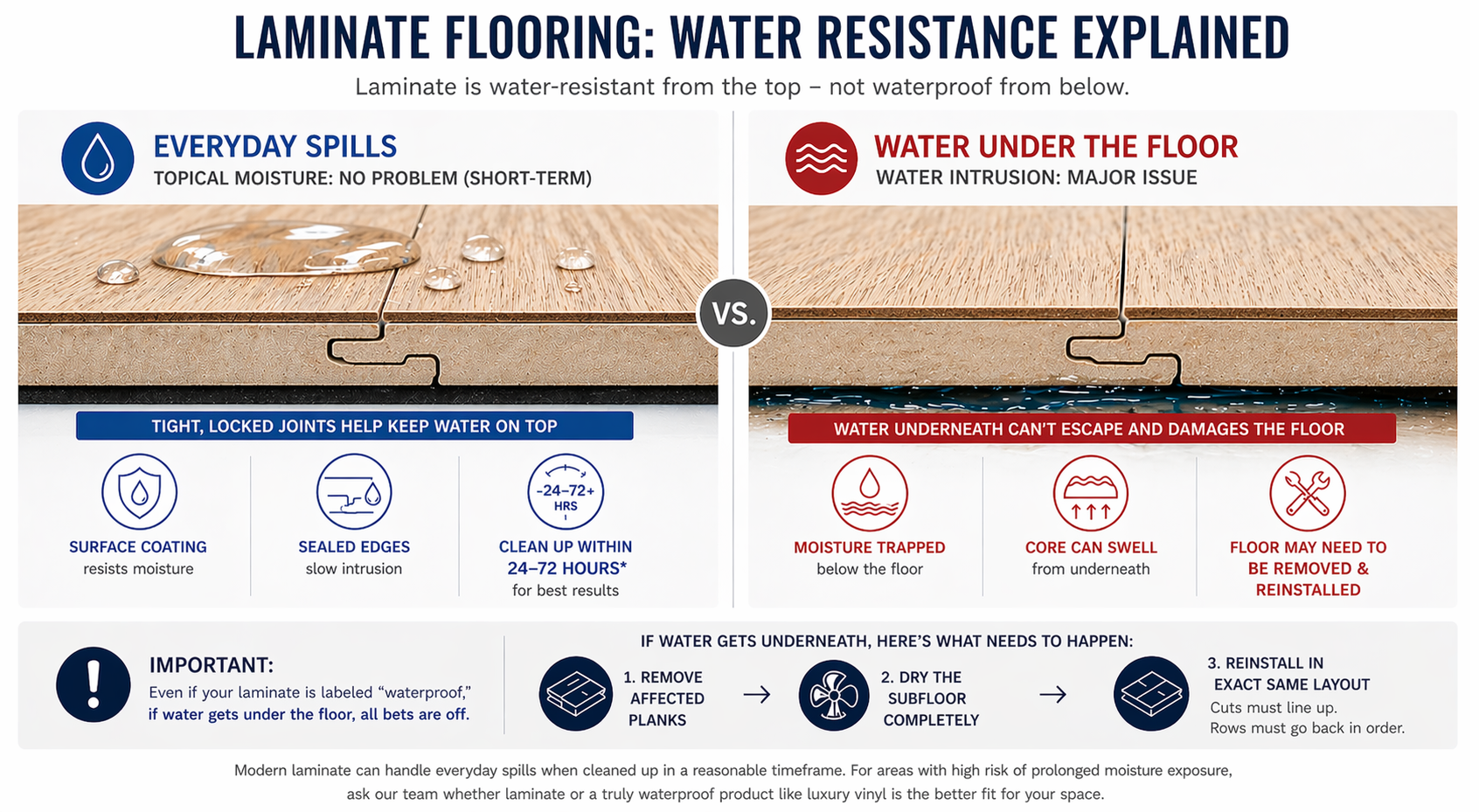
Laminate flooring has evolved significantly in recent years, and many of today’s products are marketed as “waterproof.” In practical terms, what matters most to homeowners is how the floor performs with everyday moisture, and this is where modern laminate excels. From a day-to-day living standpoint, this is the performance that truly matters. Most moisture exposure in a home happens from above, and modern laminate is engineered specifically to handle those situations.
Many of today’s laminate floors are designed to be topically waterproof or highly water resistant, meaning they are built to keep water on the surface and away from the core. Tight locking systems, sealed edges, and durable surface coatings work together to handle real-life conditions like spills, pet accidents, tracked-in rainwater, and normal household humidity. Many products are warrantied to withstand standing water for extended periods, often in the range of 24 to 72 hours.
It’s also important to understand what “waterproof” does—and does not—mean. Laminate is not waterproof in the sense that an individual plank could sit in a bucket of water indefinitely without being affected. Instead, it performs as a complete, properly installed system designed to resist moisture at the surface level.
Like any floating floor—including luxury vinyl—the one scenario that falls outside the design intent is water getting underneath the floor. In the event of a major leak or flood, moisture can become trapped below the planks, and at that point, the flooring itself is no longer the primary concern. This type of situation typically requires removal of the affected area so the subfloor can properly dry, and is generally handled through homeowner’s insurance rather than a product warranty.
For everyday living, however, modern laminate offers an excellent balance of durability, realism, and moisture performance. As the category continues to evolve, many homeowners are choosing laminate not only for its scratch resistance and natural feel underfoot, but also for its ability to handle the kinds of moisture exposure that actually occur in a home.
Common Mistakes When Buying Laminate Flooring
Choosing laminate based solely on price is one of the most common mistakes. Extremely inexpensive laminate products often reduce core density, locking strength, and surface durability to achieve lower pricing. Not all laminate is created equal. Higher-quality products use high-density HDF cores, advanced resin binders, and sealed locking systems to reduce water absorption and improve dimensional stability. Lower-cost options often lack these features and can be more susceptible to swelling when exposed to moisture. This is where differences in performance become noticeable over time. This is one reason laminate developed a negative reputation in the past—many homeowners were exposed to very low-quality products that swelled easily when exposed to moisture.
Some laminate flooring programs are sold under private-label brands created by distributors or importers. While many products perform well, quality control, warranty support, and long-term availability can vary between suppliers. Focus on manufacturers that maintain strong quality control standards, U.S. distribution networks, and technical support teams.

This budget laminate floor experienced severe joint swelling after repeated moisture exposure penetrated the seams

Why Buy from Paradise Flooring
At Paradise Flooring, we take an educational and consultative approach to flooring selection. We help customers compare flooring and select the right products based on their project-specific needs, not just marketing claims or showroom trends.
Our showroom features carefully selected products from reputable manufacturers chosen for their value, quality, performance, and suitability for Hawaii’s unique climate and lifestyle.
We hope this Buyer’s Guide has helped you better understand Laminate flooring and the important factors to consider when selecting a floor for your home or project. If you still have questions or would like help comparing options, please don’t hesitate to call, visit our showroom, or speak with our team for product guidance, samples, estimates, and installation recommendations.
Frequently Asked Questions
Is laminate flooring good for homes with pets?
Yes. Laminate flooring is one of the most durable options for homes with pets. The surface is protected by a very hard aluminum oxide wear layer that resists scratches from claws and everyday foot traffic. It is also easy to clean and maintain. As with any hard-surface floor, a few best practices help minimize wear: use felt pads under furniture, place mats near entryways to capture sand or debris, and avoid dragging heavy objects across the floor.
Is laminate flooring waterproof?
Most modern laminate flooring is marketed as waterproof or highly water-resistant against topical moisture. High-quality laminate products use waxed locking systems, dense HDF cores, tight manufacturing tolerances, and advanced surface coatings to resist moisture intrusion from everyday spills and wet mopping. Many premium products can withstand standing surface moisture for extended periods when installed properly.
However, laminate flooring is still a wood-based product at its core, so major flooding, plumbing failures, or prolonged standing water can eventually damage the floor if moisture penetrates the seams or edges. In kitchens and bathrooms, proper installation details such as perimeter sealing systems and prompt cleanup of spills become especially important.
Does laminate flooring scratch easily and how long does it last?
High-quality laminate flooring can last 15–30 years or more depending on the product quality, AC rating, installation quality, and maintenance habits. Floors installed in residential environments with proper subfloor preparation and routine care typically perform very well over long periods. Using furniture protectors, felt pads under chairs, and keeping abrasive debris off the floor can significantly extend its lifespan.
Laminate flooring is highly scratch resistant because its surface is protected by an aluminum oxide wear layer. This coating is harder than most residential flooring finishes and performs well in high-traffic areas. However, laminate is not completely scratch proof. Following basic hard-surface flooring care guidelines helps maintain the floor’s appearance over time:
• Place protective pads under chairs, heavy furniture, and appliances to distribute the load
• Lift rather than slide furniture when moving it
• Use entry mats to reduce sand and debris being tracked inside
For a quick visual guide, see our → Care and Installation Essentials.
How much does laminate flooring cost?
Laminate flooring is generally considered one of the most cost-effective hard-surface flooring options. The material itself is typically much less expensive than hardwood while still offering realistic wood visuals and excellent durability. Installation costs are also lower than many other hard-surface materials because laminate installs quickly as a floating floor. As with any flooring project, final costs can vary depending on subfloor preparation, moisture mitigation, room layout, and trim requirements.
Is laminate flooring safe for indoor air quality?
Yes—high-quality laminate flooring is generally considered safe for indoor environments when it is manufactured using low-emission core materials, resins, and adhesives and independently tested for indoor air quality. Because laminate flooring uses a wood-fiber core (typically HDF), formaldehyde emissions are one of the most important indoor air quality considerations. Reputable laminate manufacturers comply with strict emissions standards such as CARB Phase 2 and EPA TSCA Title VI regulations, which limit formaldehyde emissions from composite wood products. Many premium European laminates also meet stringent E1 or other low-emission standards.
Indoor air quality certifications such as FloorScore® and GREENGUARD Gold are also important because they evaluate a broader range of VOC emissions beyond just formaldehyde. These certifications help verify that the flooring meets strict indoor air quality standards for homes, schools, and commercial spaces.
At Paradise Flooring, we only showcase reputable manufacturers whose laminate products meet recognized indoor air quality and emissions standards such as CARB Phase 2, TSCA Title VI, FloorScore®, GREENGUARD Gold, or strict European low-emission certifications. That means you can shop confidently knowing we’ve already screened for low-emission, high-quality products from trusted manufacturers.
Read more about Air Quality here - Indoor Air Quality Blog
Can laminate flooring be installed in kitchens and bathrooms?
Yes—laminate flooring can be installed in kitchens and bathrooms when high-quality products with strong locking systems and moisture-resistant cores are used. Modern laminate floors are designed to handle everyday conditions like spills, pet accidents, tracked-in water, and normal household humidity.
That said, these areas see more frequent moisture exposure, so a few extra precautions go a long way. In bathrooms especially, we recommend sealing the perimeter of the floor to help prevent water from getting underneath the planks. Products like VersaSeal Edge Sealing Tape can provide an added layer of protection at walls, tubs, and transitions.
Managing surface moisture is also important. Using a quick-drying, breathable bath mat helps prevent water from sitting on the floor for extended periods of time, particularly around showers, tubs, and vanities. In kitchens, spills should be cleaned up promptly and plumbing leaks addressed quickly.
Like any floating floor—including luxury vinyl—laminate performs very well with everyday moisture but is not designed for standing water or flooding. As long as basic precautions are followed, laminate can be a durable and attractive option for both kitchen and bathroom spaces.
Does laminate flooring sound hollow when you walk on it?
High-quality laminate flooring often sounds and feels more like real hardwood underfoot than many other floating floors because the planks are denser and have more mass. This added rigidity helps create a more solid walking experience.
Like any floating floor, laminate is not glued directly to the subfloor, so the overall sound and feel depend heavily on proper subfloor preparation and underlayment. When the subfloor is flat and the correct acoustic underlayment is used—or when the laminate includes a quality attached pad—the floor typically feels solid and comfortable underfoot.
A hollow sound is usually the result of uneven subfloors or poor installation, rather than the laminate flooring itself.
Does laminate flooring fade in sunlight?
Laminate flooring is generally very resistant to fading because the decorative layer is not plastic and protected by a durable aluminum oxide wear surface. This protective coating helps shield the floor from ultraviolet (UV) exposure, making laminate a good choice for rooms with strong natural sunlight.
Can laminate flooring be installed over tile?
In many cases, laminate flooring can be installed over existing tile as long as the tile surface is flat, stable, and securely bonded to the subfloor. Small grout lines are usually not a problem, but large grout joints or uneven tile patterns may need to be filled or leveled before installation.
Why would I select luxury vinyl vs laminate flooring?
Luxury vinyl and laminate flooring often look very similar once installed, but their internal construction is different.
Luxury vinyl uses a PVC-based waterproof construction, which makes it well suited for kitchens, bathrooms, and areas where spills may occur. It also tends to feel softer and quieter underfoot, especially when installed with an attached acoustic pad.
Laminate uses a wood-fiber core with a very hard aluminum oxide wear surface. This construction delivers excellent scratch resistance and a firmer feel that many homeowners say is closer to real hardwood. Laminate can also perform well in areas with strong direct sunlight, since some vinyl floors may be more susceptible to fading.
Both categories offer realistic wood visuals and floating installation systems, but the best choice often depends on whether waterproof performance or scratch resistance is the higher priority.
What is the difference between laminate flooring and engineered wood flooring?
Laminate flooring uses a high-density fiberboard (HDF) core with a printed decorative layer that replicates the appearance of real wood. The surface is protected by a very hard aluminum oxide wear layer. Engineered wood flooring uses a real hardwood veneer bonded to a plywood or composite core. Laminate flooring typically offers greater scratch resistance and lower cost, while engineered wood provides the authenticity of a real wood surface.


