

Hardwood Flooring in Hawaii
Hardwood flooring remains one of the most timeless and desirable flooring choices available. Real wood brings natural warmth, character, texture, and long-term value that synthetic flooring materials can imitate but never fully duplicate. Every plank is unique, and hardwood floors can often be repaired, recoated, or refinished rather than completely replaced, making them a long-term investment in both the beauty and value of a home.
At Paradise Flooring in Honolulu, we treat hardwood as a long-term investment rather than a disposable finish material. We carefully evaluate hardwood flooring based on veneer thickness, construction quality, dimensional stability, finish systems, species selection, and long-term serviceability in Hawaii’s climate. This guide explains how hardwood flooring is constructed, how engineered and solid wood compare, and what to consider when selecting a floor for your home.

Best Uses for Hardwood Flooring in Hawaii

How Hardwood Flooring Is Constructed
Hardwood floors generally fall into three construction groups: solid hardwood, engineered hardwood, and newer hybrid wood floors (covered in a separate Buyer’s Guide).

Many old plantation-era homes in Hawaii were built with solid 3/4-inch hardwood (commonly oak or Douglas fir) flooring installed directly over floor joists. That history is one reason many customers ask for solid wood, but modern engineered hardwood often is the better choice for Hawaii because it provides better stability, wider plank options, and more installation flexibility. The next generation of hybrid wood floors is also becoming a popular upgrade option over traditional laminate or LVP.
Plank Width
Style is more than color. Width, grade, texture, and sheen determine whether the floor feels clean and modern, warm and rustic, traditional, coastal, or high-end. Narrower widths often feel more traditional and formal, while wider planks create a more open, contemporary, and luxurious appearance with fewer seams across the floor.
Traditional solid hardwood is commonly 2-1/4 inch to 4 inch wide. Board width has a major impact on the overall look and feel of a hardwood floor. Narrower solid hardwood planks, such as traditional 2-1/4" to 4" widths, create a more classic and formal appearance with more visible seams and movement across the floor. Engineered hardwood is often available in 5 inch, 7 inch, 8 inch, 9 inch, and even 12 inch widths. Wider engineered hardwood planks, commonly 7", 9", create a more open, contemporary, and luxurious feel with fewer seams and a cleaner visual flow. Random-width floors blend multiple plank sizes together for a more custom, organic, and old-world character. As plank width increases, construction quality, subfloor flatness, and dimensional stability become even more important.

Veneer Thickness and Refinishing Potential
In engineered hardwood, overall plank thickness and veneer thickness are not the same. Overall thickness affects transitions, doors, cabinets, and stair parts. Veneer thickness determines how much real hardwood is above the core and how much future sanding may be possible. A full sanding can remove about 1mm of material, so many engineered hardwood floors use veneers around 3 mm to 4 mm or thicker to allow for multiple refinishes. Thinner veneers can still perform well if the finish is maintained, but they may be limited to cleaning, screening, and recoating rather than multiple full sandings. Refinishing also allows homeowners to completely change the stain color and appearance of the floor years later without replacing the wood itself.
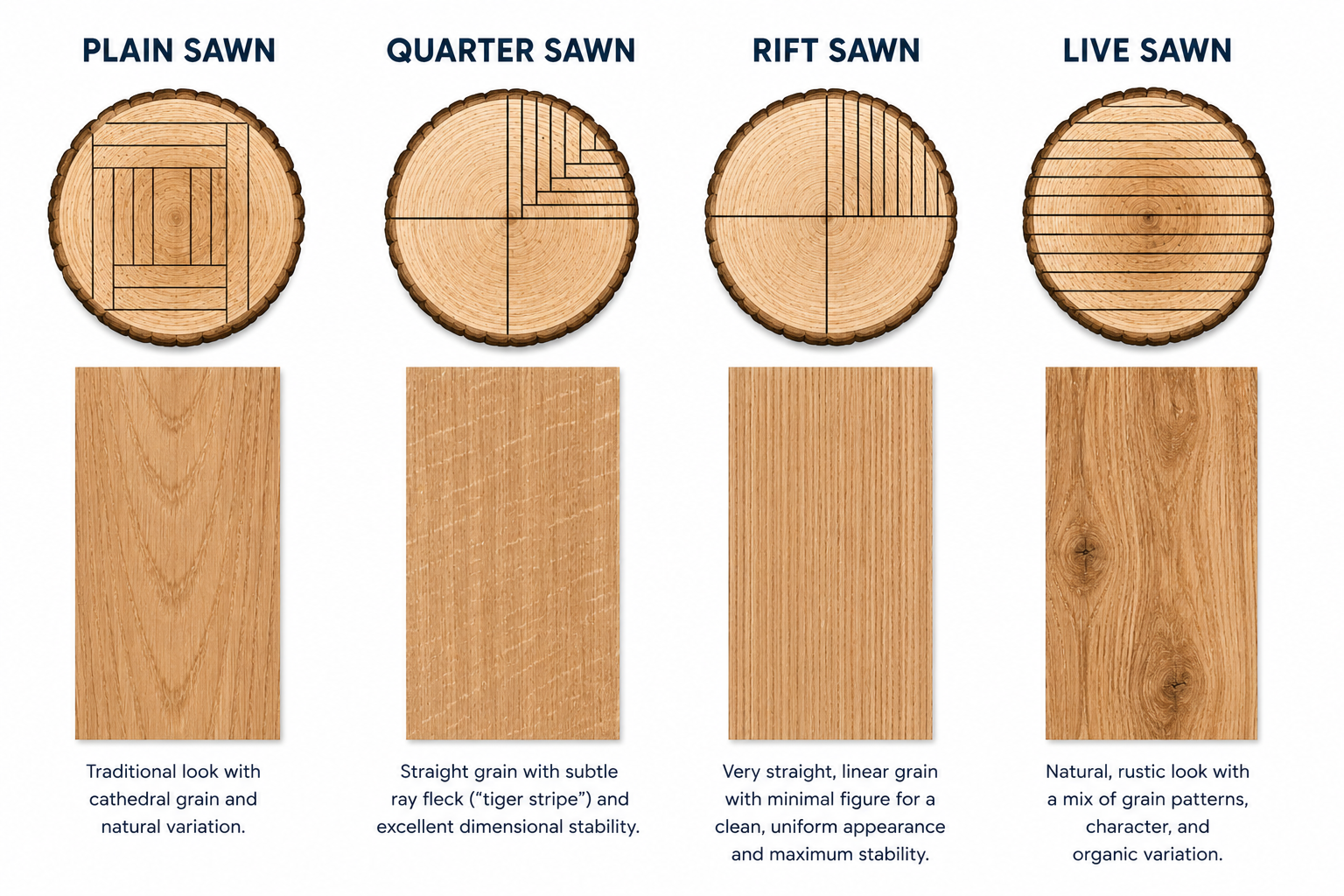
Veneers may be rotary peeled, sliced, rift sawn, or quarter sawn. Rift- and quarter-sawn veneers are often prized for straighter grain, improved stability, and a more premium visual character.
Grade
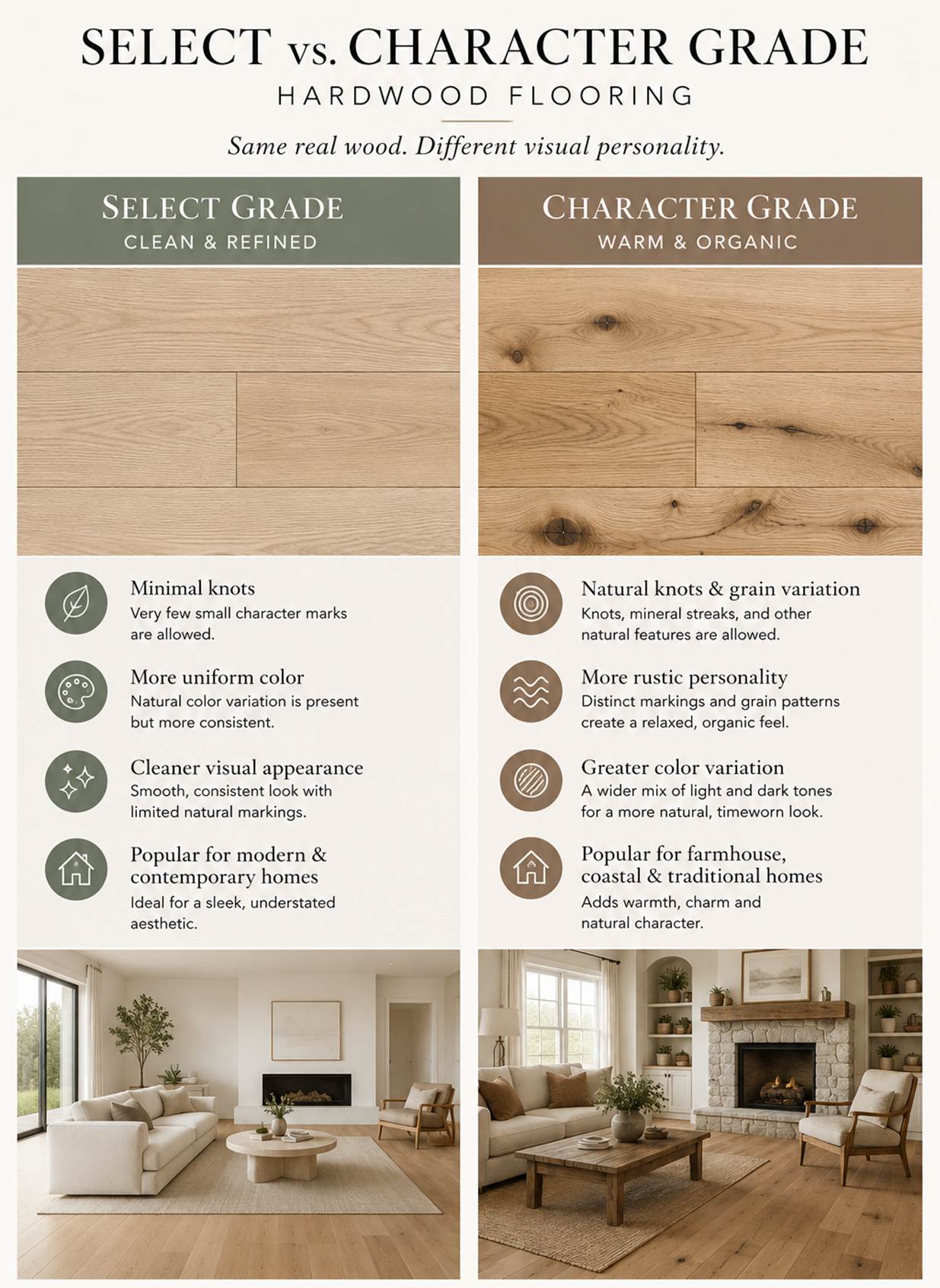
Lumber is sorted at the mill according to the visual “grade” of the wood. Select and Better grades have cleaner grain, fewer knots, and less color variation for a more minimalistic and modern look. Character grades show more knots, mineral streaks, and natural variation for a warmer or more rustic feel. Knots are usually filled during manufacturing.
Hardwood Finish Types
The finish is the protective surface on top of the wood. It affects scratch resistance, sheen, maintenance, repairability, and how the wood looks and feels.
| Finish Type | Best Known For |
|---|---|
| Factory UV-Cured Urethane or Lacquer | Durable, consistent, practical, and common on prefinished hardwood. Many include aluminum oxide or ceramic additives for abrasion resistance. |
| Site-Finished Polyurethane | Sanded and coated after installation. Good for custom stain colors and a smoother, continuous look. |
| Oil or Hardwax Oil | Natural, low-sheen look with good spot-repair potential, but requires periodic recoating. |
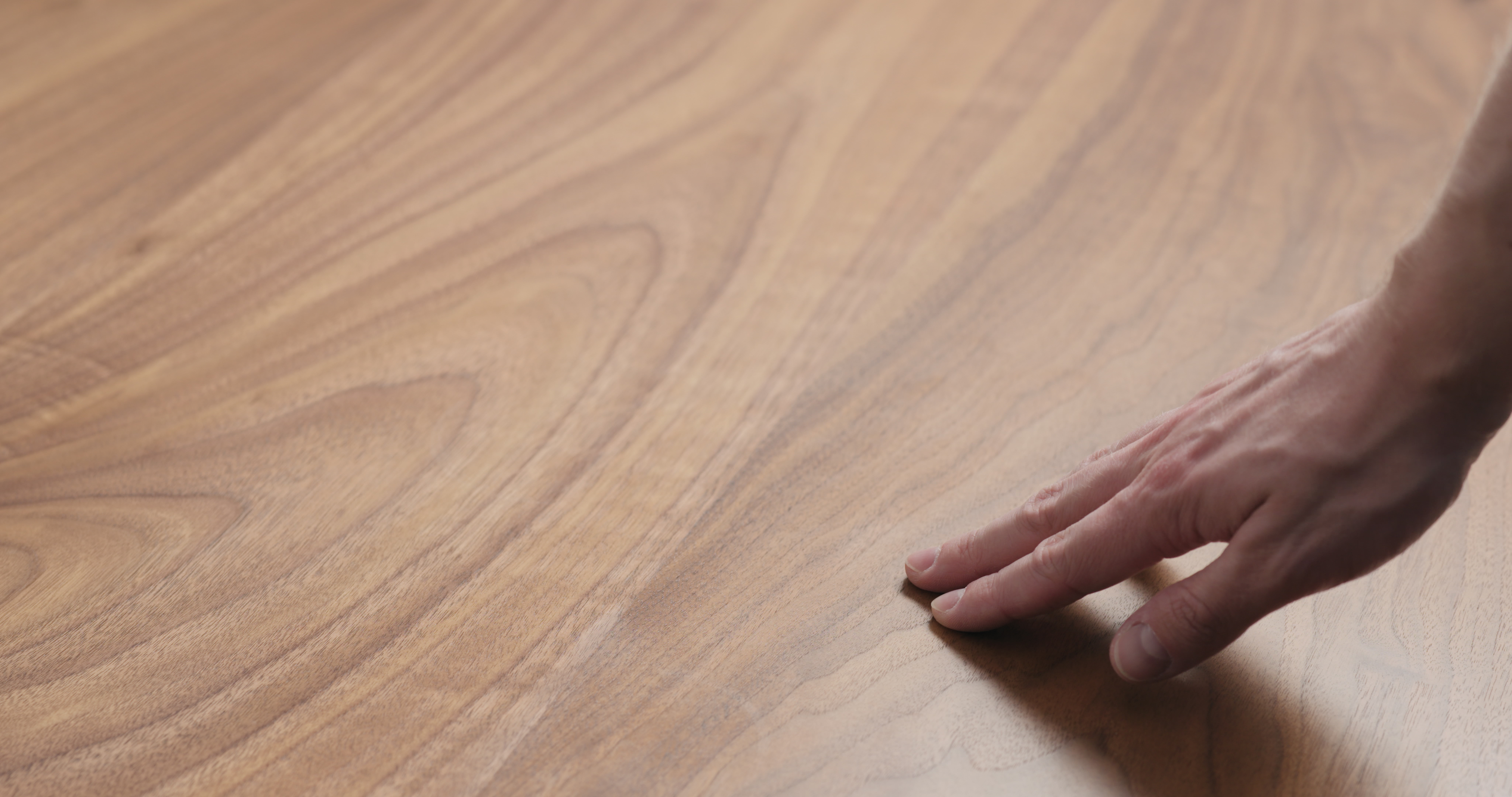
No legitimate hardwood manufacturer markets real wood as “scratch proof.” All wood floors will show wear over time, but the right species, finish, texture, and sheen can dramatically affect how visible that wear becomes.
Smooth floors look clean and refined. Wire-brushed, hand-scraped, or textured floors add character and can help disguise everyday wear. Gloss and semi-gloss look more formal but show scratches, dust, and wear more easily. Matte and ultra-matte finishes create a softer, more natural look and are currently very popular.
Species, Grain, and Hardness
Popular species include white oak for a modern versatile look, red oak for traditional warmth, maple for a cleaner light appearance, hickory for bold grain and hardness, walnut for rich brown elegance, and sapele or African mahogany for reddish-brown depth and shimmer.
All wood changes color and as it is exposed to light and oxygen. Some species amber (patina) slowly, while others darken more dramatically which is part of what gives real hardwood its long-term character and depth. Area rugs and large furniture can block light and create lighter “ghosted” areas, especially early in the floor’s life, but things will even out if you move things around periodically.
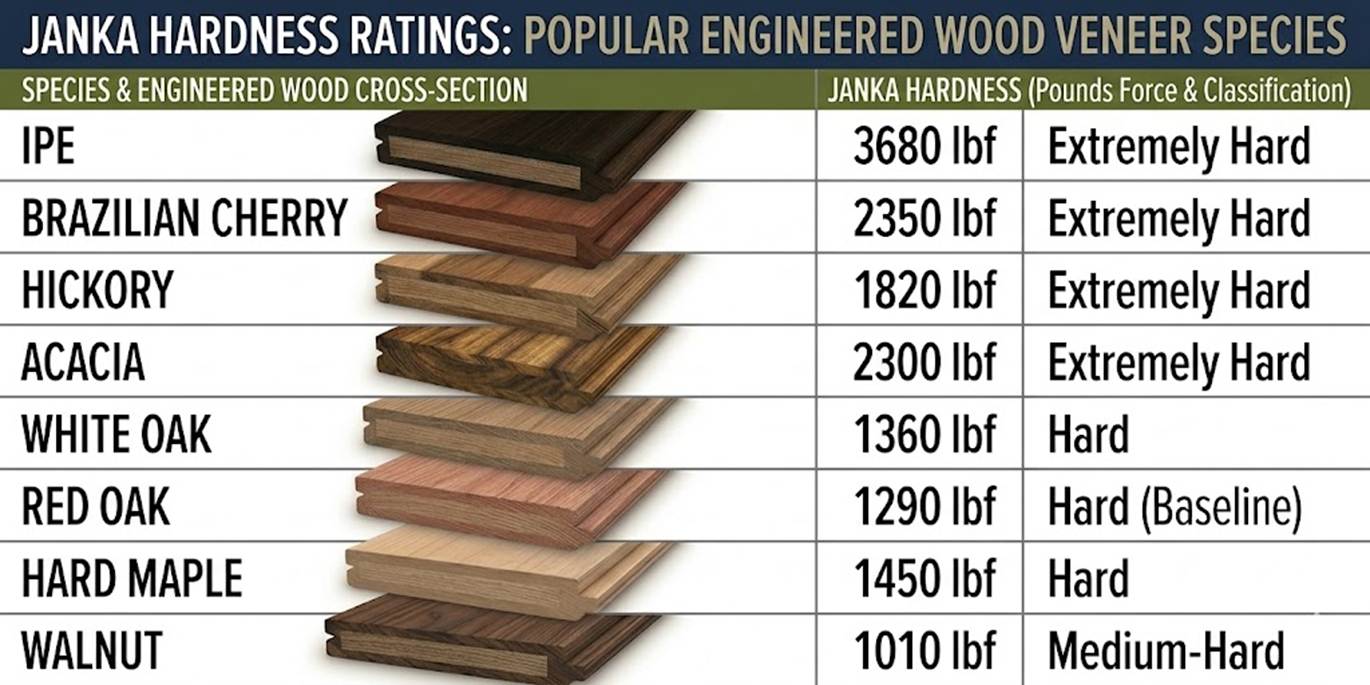
Wood species affects color, grain, hardness, movement, and overall style. The Janka hardness scale measures dent resistance, but it is only one factor. A lighter wire-brushed white oak may hide wear better than a darker glossy floor even if the darker wood is technically harder.
Installation Basics
Hardwood can be installed using floating, glue-down, nail-down, or glue-assist methods depending on jobsite and subfloor conditions. Installation is more technical than many other flooring categories because wood must be properly acclimated and moisture conditions carefully managed before installation begins. The subfloor flatness, moisture levels, adhesive system, underlayment compatibility, fastener schedule, and expansion spacing all play an important role in long-term performance. For a more detailed breakdown.
Though most hardwood floors feature a tongue-and-groove, some engineered hardwood floors, such as many collections from Kährs, use precision click-lock systems that allow the floor to be installed as a floating floor without adhesive. Floating click hardwood can be faster and more efficient to install in many homes and condominiums, especially where acoustic underlayments are common.
Modern click hardwood systems have improved significantly over the years, but construction quality, locking strength, subfloor flatness, underlayment selection, and moisture control still remain critical for long-term performance. Some projects may still benefit from glue-down or glue-assist installation methods depending on the plank size, jobsite conditions, and building requirements.
For a more detailed breakdown of hardwood installation methods, see our Hardwood Installation Methods blog.

Sustainability and Longevity
Hardwood is one of the most sustainable flooring categories when responsibly sourced and properly maintained. Wood is a renewable natural material, and unlike many synthetic flooring products, real hardwood contains very little manufactured material and no PVC. Since many hardwood floors can be recoated or refinished instead of replaced, they often stay in service far longer than other flooring products. Hardwood floors can last for generations, reducing long-term material consumption, landfill waste, and overall lifecycle cost.
Real wood flooring also has a relatively low environmental footprint compared to many heavily processed flooring materials. Wood naturally stores carbon during its service life, is biodegradable, and generates very little waste during manufacturing because wood residuals are often reused for other products or energy production.
Indoor air quality is another important consideration. Many high-quality hardwood products are available with low-VOC finishes and third-party certifications such as FloorScore®, GREENGUARD Gold, PEFC™, CARB Phase 2, and EPA TSCA Title VI compliance. These certifications help verify low emissions, responsible sourcing, and safer indoor air quality standards. At Paradise Flooring, if a hardwood product does not meet recognized indoor air quality and emissions standards, you simply will not find it in our showroom.
What to Look for When Buying Hardwood
- Confirm whether the product is solid, engineered, click engineered, or hybrid wood.
- Compare actual veneer thickness, not just total plank thickness.
- Look for stable core construction, especially for wide planks or concrete installations.
- Inspect finish type, sheen, texture, bevel, milling quality, and warranty details.
- Review installation instructions before purchase, especially for slabs, condos, stairs, or glue-down systems.
- Ask about matching stair treads/nosings, reducers, T-moldings, vents, and trims before ordering.
- Buy from a reputable manufacturer and verify it has 3rd party air quality certifications.
Common Mistakes to Avoid
Do not choose hardwood based only on color. Construction quality, finish system, installation method, veneer thickness, and site conditions all play a major role in how well the floor performs long-term. Two floors may look similar in a small sample, but the internal construction, milling quality, locking system, core stability, and finish durability can be dramatically different. It is also important to view full-sized boards or multiple samples whenever possible so you can properly evaluate the natural variation, grain character, color range, plank length, and overall visual flow of the floor.
Also avoid buying the cheapest hardwood available without understanding the tradeoffs. Hardwood is a long-term investment, and lower-quality products may be more prone to squeaks, hollow sounds, delamination, weak locking systems, inconsistent milling, excessive movement, or premature wear. Some lower-cost engineered hardwoods also use very thin veneers that may limit or completely eliminate the ability to sand and refinish the floor in the future.
Subfloor preparation is another common weak point. Hardwood requires a flat, clean, dry, and structurally sound substrate. Over concrete slabs, proper moisture testing is critical, and many projects require moisture mitigation systems or specialized adhesives designed to control vapor emissions and protect the flooring over time. Skipping moisture mitigation or using the wrong adhesive system can lead to cupping, swelling, adhesive failure, or long-term performance problems.
Over wood subfloors, the structure must be properly fastened and stable to minimize movement and squeaks. As plank widths increase, subfloor flatness, acclimation, and dimensional stability become even more important. Many hardwood flooring problems are installation-related rather than product-related, which is why proper preparation and product selection matter so much.
Care and Maintenance
Hardwood maintenance is straightforward, but the right products matter. Sweep or dust mop regularly, vacuum with a bare-floor setting, wipe spills promptly, and use only the manufacturer’s recommended hardwood cleaner because surface coatings vary. Avoid steam mops, wet mopping, oil soaps, and generic vinyl or tile cleaners unless the manufacturer specifically approves them.
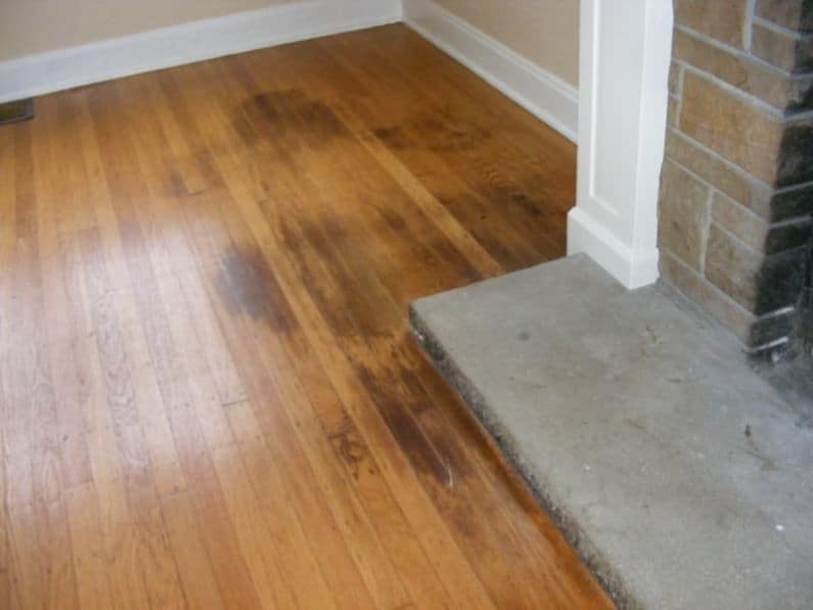
Use felt pads under furniture, trim pet nails, place breathable mats near entries, and lift heavy furniture instead of dragging it. Pet accidents and standing moisture should always be cleaned up promptly because they can discolor the wood, damage the finish, or cause staining over time. When the finish begins to show wear, many floors can be professionally cleaned, lightly abraded, and recoated before damage reaches the wood itself. → Care and Installation Essentials

Why Buy from Paradise Flooring
At Paradise Flooring, we take an educational and consultative approach to flooring selection. We help customers compare flooring and select the right products based on their project-specific needs, not just marketing claims or showroom trends.
Our showroom features carefully selected products from reputable manufacturers chosen for their value, quality, performance, and suitability for Hawaii’s unique climate and lifestyle.
We hope this Buyer’s Guide has helped you better understand Hardwood flooring and the important factors to consider when selecting a floor for your home or project. If you still have questions or would like help comparing options, please don’t hesitate to call, visit our showroom, or speak with our team for product guidance, samples, estimates, and installation recommendations.
Frequently Asked Questions
Is hardwood flooring good for Hawaii homes?
Yes—hardwood flooring can perform very well in Hawaii homes when the right product and installation method are selected. Engineered hardwood is often preferred in Hawaii because it offers greater dimensional stability in changing humidity conditions and can typically be installed over properly prepared concrete slabs commonly found in island construction.
Solid hardwood can also perform beautifully, particularly over plywood subfloors, but it generally requires more jobsite control, acclimation, and moisture management. In condominiums and high-rise buildings, additional considerations such as moisture mitigation, adhesive systems, acoustic underlayments, and AOAO sound requirements may also apply.
At Paradise Flooring, we help homeowners select hardwood products specifically suited for Hawaii’s climate, construction methods, and lifestyle needs.
What is the difference between solid and engineered hardwood?
Both solid and engineered hardwood use real wood surfaces, but the internal construction is different.
Solid hardwood is made from a single piece of wood throughout the plank. It can typically be sanded and refinished multiple times, but it is also more sensitive to moisture and humidity changes.
Engineered hardwood uses a real hardwood veneer bonded over multiple layers of plywood or engineered core materials. This layered construction improves dimensional stability, making engineered hardwood less prone to expansion and contraction from environmental changes. It also allows engineered hardwood to be installed in more environments, including over concrete slabs and in many condominium applications.
Many premium engineered hardwood floors use thick hardwood veneers that may still allow future professional refinishing, depending on the product and overall floor condition.
Is hardwood flooring waterproof? Can it be installed in kitchens?
No natural wood floor is completely waterproof. Hardwood is a hygroscopic material, meaning it naturally expands and contracts in response to moisture and humidity changes.
That said, hardwood flooring can absolutely be used successfully in kitchens and many active households when properly maintained. Everyday spills are usually not a problem if cleaned promptly, but standing water, prolonged moisture exposure, or repeated pet accidents can eventually damage the wood, stain the finish, or cause swelling.
Engineered hardwood generally offers better moisture resistance and dimensional stability than solid hardwood, but neither should be considered a true waterproof flooring product like luxury vinyl or porcelain tile.
For homeowners who want the look and feel of real hardwood with improved waterproof performance, newer waterproof hardwood flooring collections offer an interesting middle ground. These products use real wood surfaces combined with waterproof core technologies that provide greater moisture resistance than traditional engineered hardwood. However, there are tradeoffs. Many waterproof hardwood products use thinner hardwood veneers or specialized construction methods that may limit or eliminate the ability to sand and refinish the floor in the future.
How durable is hardwood flooring? Is hardwood good for dogs?
Hardwood flooring is highly durable, but no wood floor is completely scratch proof. Harder species such as white oak, maple, and hickory generally resist denting better than softer species, while finish quality, texture, sheen level, and overall floor construction all influence how wear appears over time.
For homes with pets, matte and textured finishes are often popular because they help visually hide scratches, dust, and everyday wear. Wider color variation and natural character grading can also make minor surface wear less noticeable.
The Janka hardness scale is commonly used to compare dent resistance between wood species, but real-world durability also depends heavily on the quality of the finish and how the floor is maintained.
Simple practices such as using felt pads, keeping pet nails trimmed, and minimizing sand or debris tracked into the home can significantly extend the life of the floor.
For a quick visual guide, see our → Care and Installation Essentials.
How long does hardwood flooring last? Can it be refinished?
A properly installed and maintained hardwood floor can last for decades, and many wood floors remain in service for generations.
One of hardwood’s biggest advantages is renewability. Solid hardwood can typically be sanded and refinished multiple times over its lifespan. Engineered hardwood flooring may also be refinishable depending on the thickness of the hardwood veneer layer and the condition of the floor.
Premium engineered hardwood products commonly use thicker veneers that may allow future professional refinishing, while thinner veneers may be more limited to maintenance coats or light professional sanding.
In many cases, hardwood floors can be refreshed rather than completely replaced, helping extend the life of the floor and reduce long-term ownership costs.
What finish is best for hardwood flooring?
The best hardwood finish depends on the desired appearance, maintenance expectations, and installation method.
For most busy homes, factory-prefinished UV-cured urethane finishes offer excellent durability, scratch resistance, and faster installation with minimal odor or disruption. Site-finished polyurethane systems allow greater customization and can create a smoother, more continuous appearance because the floor is sanded and finished after installation.
Oil and hardwax oil finishes provide a more natural appearance and can allow easier spot repairs, but they typically require more ongoing maintenance than polyurethane finishes.
Sheen level also affects long-term appearance. Matte and low-sheen finishes tend to hide scratches, dust, and surface wear better than high-gloss finishes.
The best choice ultimately depends on the design goal, lifestyle, budget, and long-term maintenance expectations.
Will hardwood flooring change color over time?
Yes. Hardwood is a natural material, and most wood species will gradually change color as they age and are exposed to light and oxygen. This natural aging process is often called patina development.
Some species darken over time, while others lighten or become warmer in tone. Direct sunlight and UV exposure can accelerate these changes, which is why rugs and furniture sometimes leave lighter or darker outlines on the floor during the first several months or years.
Natural variation and color change are considered normal characteristics of real hardwood flooring and are part of what gives wood floors their unique long-term character and appearance.
Is hardwood flooring safe for indoor air quality?
Yes—high-quality hardwood flooring is generally considered safe for indoor environments when it is manufactured using low-emission finishes, adhesives, and engineered core materials and independently tested for indoor air quality.
For engineered hardwood flooring, indoor air quality considerations are especially important because the construction may include plywood or composite core layers bonded with adhesives and resins. Reputable manufacturers comply with strict emissions standards such as CARB Phase 2 and EPA TSCA Title VI regulations, which limit formaldehyde emissions from composite wood products. Many premium European hardwood manufacturers also meet stringent E1 or other low-emission standards.
Indoor air quality certifications such as FloorScore® and GREENGUARD Gold are also important because they evaluate a broader range of VOC emissions from flooring products, finishes, and adhesives. These certifications help verify that the flooring meets strict indoor air quality standards for homes, schools, and commercial spaces.
Sustainability certifications may also apply to hardwood flooring. Organizations such as FSC® (Forest Stewardship Council) and PEFC™ (Programme for the Endorsement of Forest Certification) certify responsibly managed forest products and sustainable sourcing practices.
At Paradise Flooring, we only showcase reputable manufacturers whose hardwood products meet recognized indoor air quality and emissions standards such as CARB Phase 2, TSCA Title VI, FloorScore®, GREENGUARD Gold, FSC®, PEFC™, or strict European low-emission certifications. That means you can shop confidently knowing we’ve already screened for low-emission, high-quality products from trusted manufacturers.
As with any building material, overall indoor air quality also depends on proper ventilation, installation practices, and the quality of any adhesives or finishes used during installation. Read more about Air Quality here.
Why would I choose hardwood instead of luxury vinyl or laminate?
Hardwood flooring offers the natural beauty, texture, and long-term character of real wood, which many homeowners consider difficult to fully replicate with manufactured flooring products.
Compared to luxury vinyl or laminate, hardwood can often increase long-term resale appeal and may be renewable through sanding and refinishing rather than full replacement. Hardwood also develops natural patina and character over time, which many homeowners appreciate.
Luxury vinyl flooring typically offers better waterproof performance, lower maintenance requirements, and greater dimensional stability in high-moisture environments. Laminate flooring often provides excellent scratch resistance and durability at a lower overall cost.
The best choice ultimately depends on the desired appearance, maintenance expectations, environmental conditions, budget, and long-term goals for the space.


