

Luxury Vinyl Flooring in Hawaii
Luxury vinyl flooring has become one of the most popular flooring categories because it offers a practical balance of waterproof performance, durability, comfort, and affordability. Modern luxury vinyl floors can realistically replicate the appearance of hardwood or stone while providing a softer, quieter, and more forgiving feel underfoot than many traditional hard-surface materials. Its combination of style and practicality makes it especially attractive for active households and modern island living.
At Paradise Flooring in Honolulu, we focus on high-quality luxury vinyl flooring collections selected to perform well in Hawaii’s climate and lifestyle. We evaluate luxury vinyl flooring based on core construction, wear-layer durability, locking systems, dimensional stability, acoustics, serviceability, and long-term waterproof performance. This guide explains how luxury vinyl flooring is built, where it performs best, and what to consider when comparing products.

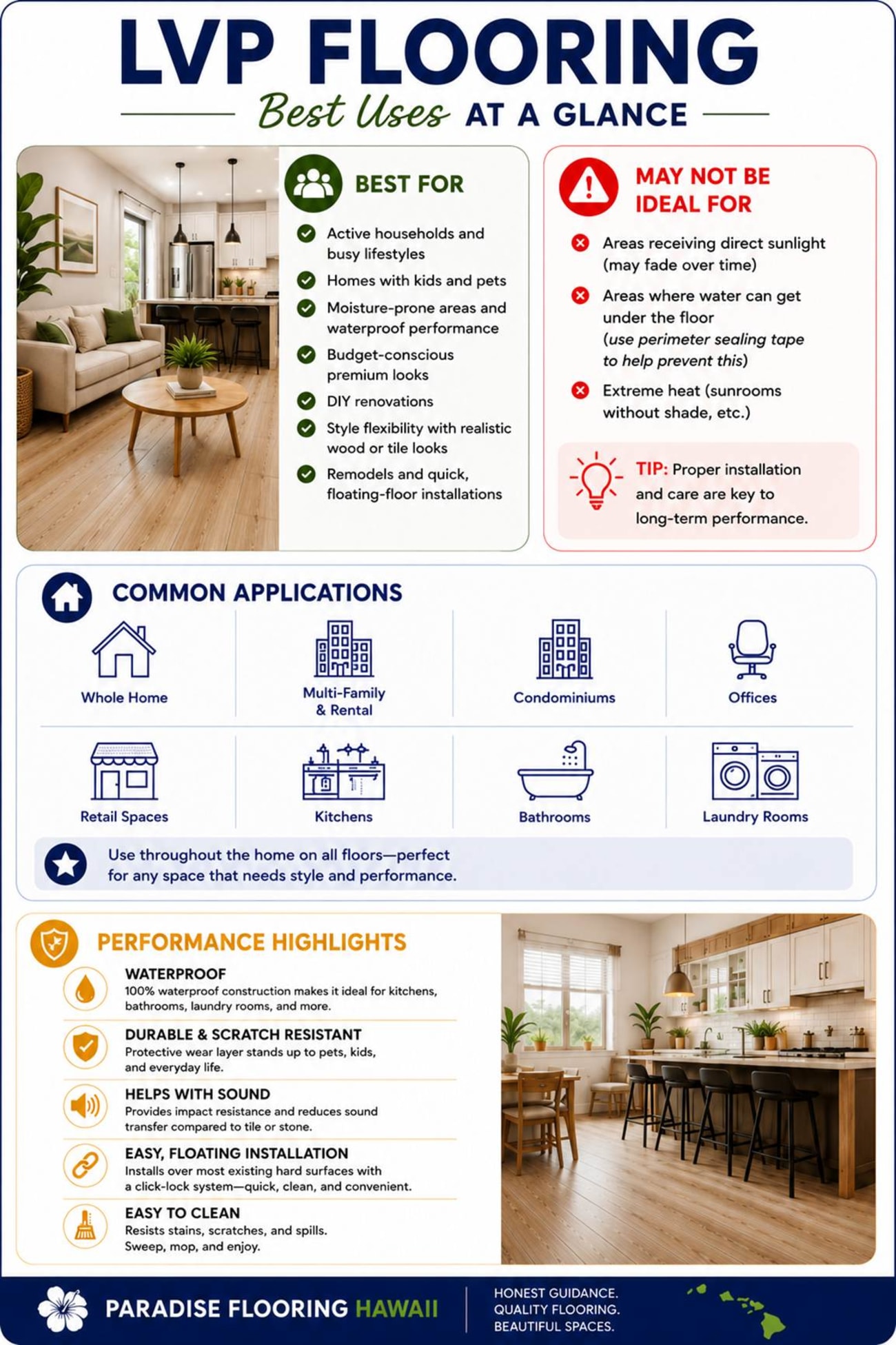
Best Uses for Luxury Vinyl in Hawaii
How Click-Lock Luxury Vinyl Flooring Is Typically Constructed
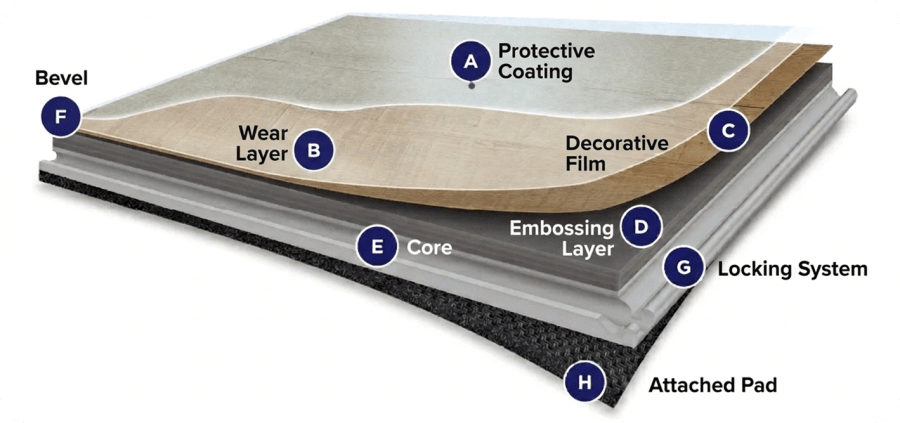
Protective Coating (A)
Protective coating protects the wear layer. Some coatings include ceramic bead or aluminum oxide additives to improve scratch resistance. Certain manufacturers, such as Karndean, offer restoration kits that allow the polyurethane surface to be refreshed over time.
The Wear Layer (B)
The wear layer protects the decorative film and is measured in mils (1/1000 inch). Typical ranges include 12 mil for residential use, 20 mil for heavy residential or light commercial applications, and 30 mil or more for higher-traffic commercial environments.
Decorative Film (C)
Decorative film provides the visual design. Premium options have sharper more unique visuals with less pattern repeats.
Embossing Layer (D)
Embossing layer to simulate wood or stone. Higher-end floors feature Embossed in-Register (EIR) technology to align the surface texture with the wood grain for a truly authentic appearance.
The Core (E)
The core provides rigidity and stability. Most rigid-core luxury vinyl floors range from approximately 4.5 mm to 8 mm thick, which is generally considered the performance “sweet spot” for most applications. However, newer ultra-thick products in the 10–12 mm range have recently entered the market. Ultra-thick products often have more robust locking systems, sound quieter, feel more substantial when walked on, and can be slightly more forgiving over minor subfloor imperfections. Ultra-thick products can also be useful when matching the height of adjacent flooring surfaces such as tile, helping create smoother transitions between rooms and reducing height differences at doorways.
Bevel (F)
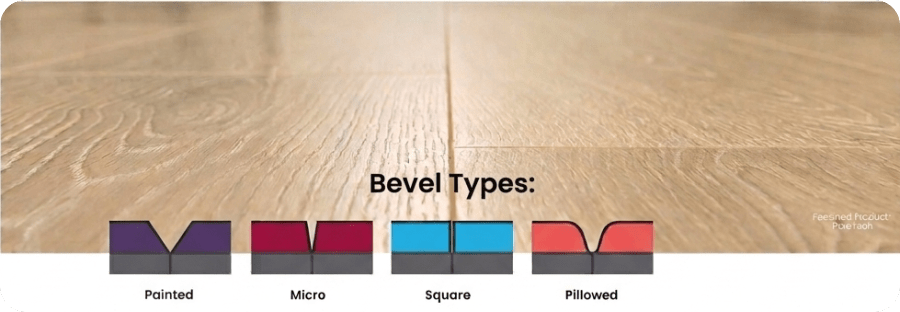
The bevel is defines the joint between planks. A common misconception is that sand and debris will get caught in deeper painted bevels, but it’ll come out with a light vacuuming or dry cloth mop (i.e. Swiffer). Micro and Square bevels are a popular choice, and higher end options will wrap the decorative film into the bevel or have a pillowed edge to lessen the visual footprint of the seams.
Locking System (G)
The locking system is one of the most important components. Strong, well-engineered systems like Valinge® or Unilin® keep planks tightly connected while allowing for natural expansion and contraction.
Attached Pad (H)
Most products include an attached pad made of IXPE foam, rubber, or cork to reduce sound transmission. A supplemental underlayment can be installed, but it must be ultra-low compression and approved for use under pad-attached floors. For more information, see our Flooring Acoustics Blog Article.
SPC vs WPC Core Construction

Two core constructions dominate the rigid-core luxury vinyl market
SPC Flooring
Stone Plastic Composite (SPC) floors use a dense limestone-reinforced core that provides excellent dimensional stability, dent resistance, and a firmer feel underfoot. SPC floors are typically thinner but denser, making them a popular choice for high-traffic homes, commercial environments, and areas with heavy furniture.
WPC Flooring
Wood Plastic Composite (WPC) floors use a thicker foamed core that feels softer, warmer, and quieter underfoot. Despite the name, most modern WPC floors contain little or no actual wood; today most products are primarily engineered waterproof polymer composites with foaming agents that improve comfort and acoustics. Since WPC cores are thicker and slightly more resilient underfoot, they are often preferred in residential environments where comfort and sound reduction are priorities.
Installation Considerations
Click‑lock luxury vinyl is one of the easiest hard‑surface floors to install. Planks can typically be scored and snapped or cut with a guillotine cutter, which speeds installation compared to materials that require saws or adhesives.
Subfloor preparation is important and moisture mitigation is required when installing over a concrete slab-on-grade. In the case of a catastrophic flood where water becomes trapped beneath the floor, removal and drying is necessary.
Proper expansion gaps, using transitions at the proper locations, and avoiding heavy objects (like cabinets and pool tables) on top of floating floors are important for long-term performance. LVP can fade so make sure to choose high performance “Low-E” UV-filtering glass or install window treatments, especially in Hawaii homes with large sliding doors or strong direct sunlight.
Floor height and transitions should also be considered during product selection. Thicker luxury vinyl floors can sometimes help better match the height of adjacent flooring surfaces such as tile or stone, creating smoother transitions between rooms and reducing the need for pronounced transition moldings or height reducers.
While this guide focuses on click-lock floating floors, other installation systems such as glue-down or loose-lay modular vinyl floors are also used in commercial environments where plank replacement speed is important.

Luxury vinyl installation at a home in Kaneohe.
What to Look for When Comparing Luxury Vinyl Floors
Once you have selected the visual style, the most important differences between luxury vinyl floors are often the ones you do not see. While overall thickness and wear layer are two of the most commonly discussed specifications, both are frequently misunderstood, and neither alone is a reliable indicator of quality. Factors such as core construction, locking system design, and overall manufacturing quality have a much greater impact on how the floor performs over time.
Overall plank thickness should always be evaluated in context. Extremely thin floors should generally be avoided, but thicker does not automatically mean better. Many premium rigid-core floors today fall within the 5–8 mm range and already provide excellent long-term performance.
Newer ultra-thick 10–12 mm products can offer benefits such as improved sound reduction, greater comfort underfoot, and a more substantial “hardwood-like” feel. Thicker flooring can also help reduce the difference in height to adjacent surfaces like tile. However, these benefits are largely related to acoustics and comfort rather than scratch resistance or waterproofing..
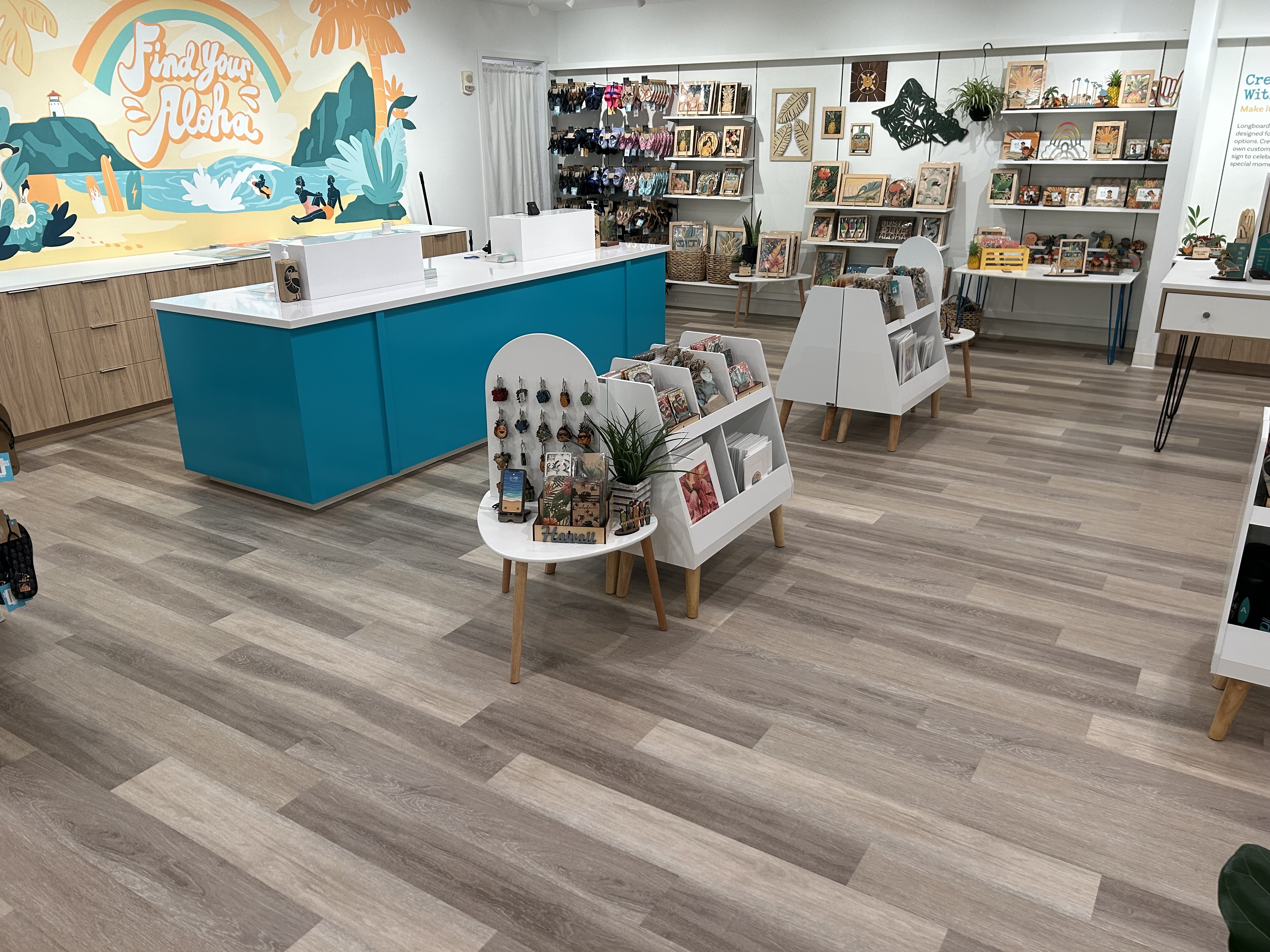
20-mil luxury vinyl performing in a busy retail environment.
Scratch resistance is primarily determined by the wear layer and protective finish—not overall plank thickness. A high-quality 6.5–8 mm floor with a strong locking system and durable finish will often outperform a thicker lower-quality product.
Wear layer ratings are another area where marketing can create confusion. Many manufacturers now promote ultra-thick 28–30 mil wear layers because consumers often assume that more is always better. In reality, a 12 mil wear layer is sufficient for most residential applications, and many products at that level already carry lifetime residential wear warranties. Meanwhile, many 20 mil products are specifically designed for commercial use. For the majority of homes, extremely thick wear layers provide little practical benefit.
Just as important as the wear layer itself is the quality of the protective finish, which plays a major role in scratch resistance, stain resistance, and overall durability.
Core construction is equally important. SPC (stone plastic composite) cores are dense and rigid, offering excellent dimensional stability and dent resistance. WPC (wood plastic composite) cores are typically thicker and provide a softer, quieter feel underfoot. Higher-quality floors also tend to use 100 percent virgin vinyl rather than recycled fillers, which can make planks more brittle and weaken locking systems over time.
Finally, choose flooring from a reputable manufacturer with strong quality assurance standards and reliable product support. Established brands are more likely to provide phthalate-free products, consistent manufacturing quality, and comprehensive third-party testing for flammability, slip resistance, abrasion resistance, dimensional stability, indentation, and acoustical performance. Look for independent indoor air quality certifications such as FloorScore or GREENGUARD Gold, which verify that the flooring meets strict VOC emission standards. At Paradise Flooring, if a product does not meet recognized indoor air quality and emissions standards, you simply will not find it in our showroom. Read more about Air Quality here.
Common Mistakes When Buying Luxury Vinyl
Choosing flooring based only on price
Extremely inexpensive products often achieve their cost by reducing core density, locking strength, or wear‑layer quality. Some private-label flooring programs may not offer the same level of long-term technical support or replacement availability as established reputable manufacturers.
Overlooking the Locking System
Poorly engineered locking profiles are one of the most common causes of plank separation. Lower-quality floors sometimes use simplified locking profiles that are more prone to plank separation or joint failure over time. Well-engineered locking systems such as Valinge or Unilin designs help keep planks tightly connected while still allowing the floor to move naturally.
Ignoring subfloor preparation and moisture testing
Even the best flooring materials can perform poorly if the substrate is not properly prepared. Luxury vinyl requires a flat, clean, and stable substrate and proper moisture mitigation is important when installing on a concrete slab-on-grade.

Why Buy From Paradise Flooring
At Paradise Flooring, we take an educational and consultative approach to flooring selection. We help customers compare flooring and select the right products based on their project-specific needs, not just marketing claims or showroom trends.
Our showroom features carefully selected products from reputable manufacturers chosen for their value, quality, performance, and suitability for Hawaii’s unique climate and lifestyle.
We hope this Buyer’s Guide has helped you better understand Luxury Vinyl flooring and the important factors to consider when selecting a floor for your home or project. If you still have questions or would like help comparing options, please don’t hesitate to call, visit our showroom, or speak with our team for product guidance, samples, estimates, and installation recommendations.
Frequently Asked Questions
Is luxury vinyl flooring waterproof?
Luxury vinyl flooring is topically waterproof, meaning the planks themselves are not damaged by spills, pet accidents, or everyday moisture. That makes it a great option for kitchens, bathrooms, and homes with active lifestyles.
However, “waterproof” does not mean a floor is immune to all water-related problems. Water can still migrate beneath the flooring during floods, plumbing failures, or prolonged standing water conditions. Moisture trapped beneath the floor can sometimes affect adhesives, underlayments, subfloors, or create conditions for mold and mildew if not addressed properly.
Proper installation, subfloor preparation, moisture testing, and prompt cleanup of major leaks remain important for long-term performance.
Is luxury vinyl good for homes with pets?
Yes. Luxury vinyl flooring is one of the most pet-friendly flooring options available. Unlike hardwood or tile, luxury vinyl resists moisture from occasional accidents, cleans easily, and is comfortable underfoot for both people and pets. Many homeowners also appreciate that vinyl can provide better traction than tile while still being durable and easy to maintain.
Does luxury vinyl scratch and how long does it last?
High-quality luxury vinyl flooring can last 15–30 years or more, depending on the wear layer thickness, installation quality, and maintenance.
Proper care can significantly extend the life of the floor. Following general hard-surface flooring best practices—such as using furniture protectors, felt pads under chairs, and avoiding dragging heavy furniture—helps prevent unnecessary wear. Link to our Hard Surface Flooring Care Infographic for a quick reference.
Luxury vinyl flooring is scratch resistant, but not scratch proof. Floors with thicker wear layers and high-quality polyurethane coatings generally perform better over time. As with any hard-surface floor, simple best practices help prevent unnecessary wear:
• Place protective pads under chairs, heavy furniture, and appliances to distribute the load
• Lift rather than slide furniture when moving it
• Use entry mats to reduce sand and debris being tracked inside
For a quick visual guide, see our Care and Installation Essentials.
How much does luxury vinyl flooring cost?
Luxury vinyl flooring is generally considered one of the most cost-effective hard-surface flooring options.
The material itself is typically less expensive than hardwood or porcelain tile, while still providing realistic wood or stone visuals and strong durability. Pricing varies depending on construction quality, wear-layer thickness, and design features such as embossing and bevels.
Installation costs are also usually lower than other hard-surface materials. In many cases, luxury vinyl installation costs about half the cost of hardwood installation and roughly one-third the cost of porcelain tile installation. This is largely because vinyl planks install more quickly and do not require sanding, finishing, or grout work.
As with any flooring project, the final cost can vary depending on subfloor preparation, moisture mitigation, and room layout. Concrete slabs should always be moisture tested before installation, and additional preparation may be required to ensure long-term performance.
Is luxury vinyl flooring safe for indoor air quality?
Yes—high-quality luxury vinyl flooring is generally considered safe for indoor environments when it is independently certified for low VOC emissions and manufactured without ortho-phthalates.
At Paradise Flooring, we ONLY showcase reputable manufacturers whose products are independently certified to meet recognized indoor air quality standards such as FloorScore® or GREENGUARD Gold and are phthalate-free.
That means you can shop without worrying about researching VOC certifications, chemical disclosures, or product safety standards yourself—we’ve already done the screening and product evaluation for you so you can shop worry-free.
Read more about Air Quality here.
Can luxury vinyl flooring be installed in condos in Hawaii?
Yes, but many condominium buildings in Hawaii require flooring systems to meet specific sound transmission ratings (IIC/STC).
Luxury vinyl floors with attached acoustic pads—or approved underlayments—are often used to meet those requirements. Before installation, review your building’s guidelines to ensure compliance. If you’re unsure, we can help you select a floor and underlayment that meet typical AOAO requirements.
Read more about acoustics here
Can luxury vinyl flooring be installed over tile?
In many cases, yes. Luxury vinyl flooring can often be installed over existing tile as long as the surface is flat, stable, and well bonded to the subfloor. Small grout lines usually aren’t an issue, especially with thicker rigid-core vinyl floors.
However, large grout joints or uneven tile patterns may need to be filled or leveled before installation to prevent telegraphing. If the tile is loose or uneven, it’s usually better to remove it and prepare the subfloor properly.
Can damaged luxury vinyl planks be replaced?
Yes. One advantage of click-lock luxury vinyl flooring is that individual planks can often be replaced if they become damaged. For click-lock floating floors, repairs typically involve carefully disassembling the floor from the nearest wall back to the damaged area, replacing the affected plank, and then reinstalling the surrounding boards. This approach preserves the locking system and generally provides the best long-term repair result.
In situations where disassembly is impractical, experienced installers can sometimes perform a “surgical” plank replacement by cutting out the damaged plank and bonding a new plank into place. However, this method depends on the flooring product, the location of the damage, and the condition of the surrounding locking system.
Since luxury vinyl products can change over time, it is also a good idea to keep extra planks from the original installation for future repairs. This repairability is one reason luxury vinyl is popular in rental properties, commercial spaces, and vacation homes.
Why would I select luxury vinyl vs laminate flooring?
Luxury vinyl and laminate flooring often look very similar once installed, but their internal construction is different.
Luxury vinyl uses a PVC-based waterproof construction, which makes it well suited for kitchens, bathrooms, and areas where spills may occur. It also tends to feel softer and quieter underfoot, especially when installed with an attached acoustic pad.
Laminate uses a wood-fiber core with a very hard aluminum oxide wear surface. This construction delivers excellent scratch resistance and a firmer feel that many homeowners say is closer to real hardwood. Laminate can also perform well in areas with strong direct sunlight, since some vinyl floors may be more susceptible to fading.
Both categories offer realistic wood visuals and floating installation systems, but the best choice often depends on whether waterproof performance or scratch resistance is the higher priority.
Read more about Laminate here
Why would I select luxury vinyl vs hardwood flooring?
Hardwood flooring is valued for natural beauty and long-term resale appeal, but it is sensitive to moisture and humidity changes, which can lead to expansion, contraction, or warping.
Luxury vinyl offers a more dimensionally stable and moisture-resistant alternative, making it easier to maintain in environments where humidity fluctuates. Another major difference is installation cost: hardwood installation is typically more complex, while luxury vinyl can often be installed more quickly and at a lower labor cost.
For many homeowners, luxury vinyl provides the appearance of wood with less maintenance and a lower overall installed cost.
Read more about Hardwood here
Why would I select luxury vinyl vs porcelain tile?
Porcelain tile is extremely durable and fully waterproof, which makes it a popular choice in bathrooms and high-moisture environments.
However, tile surfaces are hard and cold underfoot, and installation can be significantly more labor-intensive. Also, grout needs to be periodically sealed (c’mon – who does this?) so it doesn’t soak up a spilled merlot or spaghetti sauce, which isn’t a concern with a simulated vinyl groutline. Luxury vinyl tile can replicate many stone or tile visuals while offering a warmer, more comfortable walking surface. Installation is also typically faster and less disruptive.
Luxury vinyl tile can be a practical alternative for homeowners who want the look of tile without grout maintenance or the cold, hard feel of tile.
Read more about Tile here


